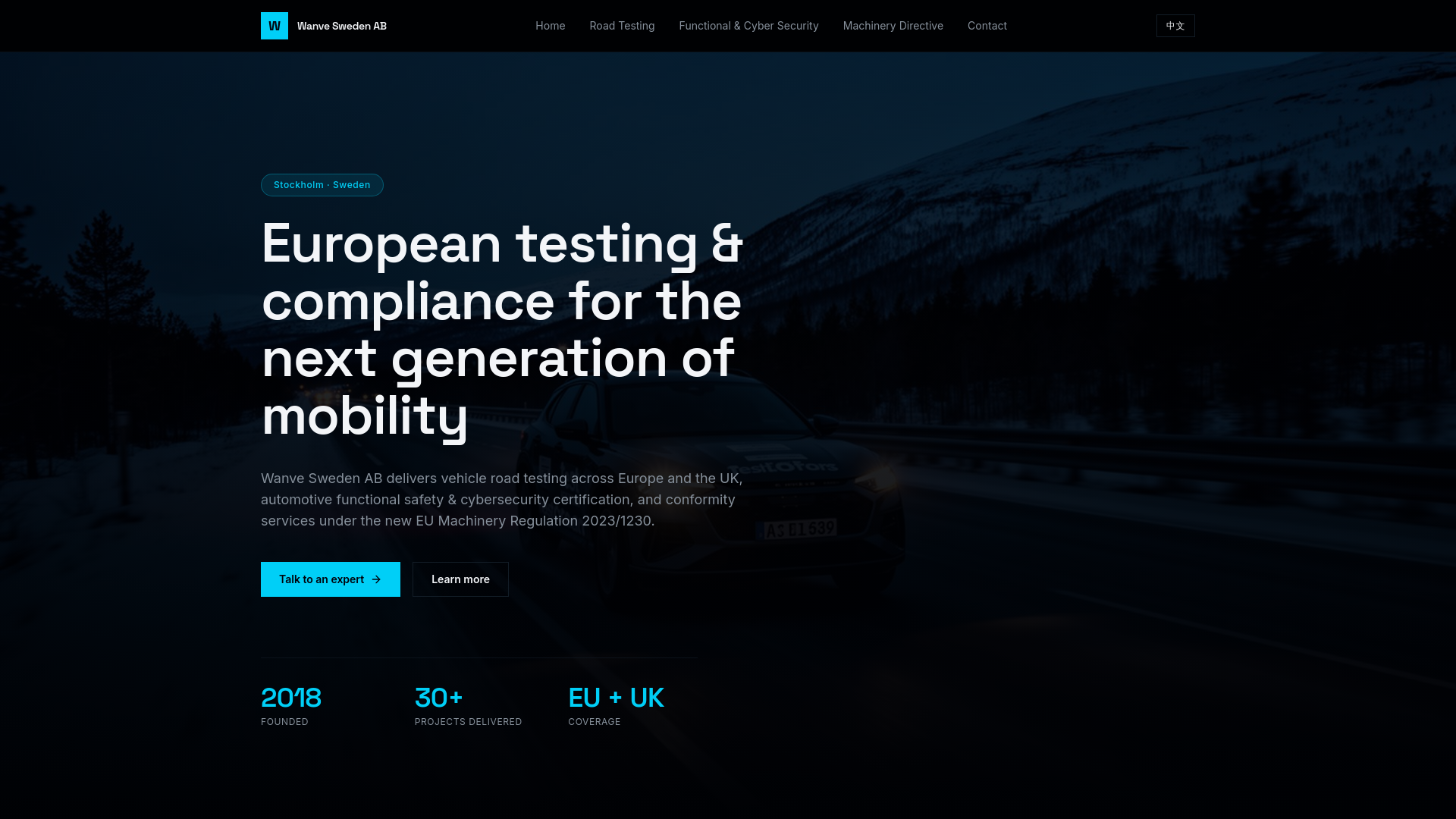
Wanve Sweden AB — European Mobility Testing & Compliance
www.wanve.se
Oct. 10, 2026, 4:13 a.m.
Wanve Sweden AB operates as the European hub of the Wanve Group's Cyber & Functional Safety Division, delivering comprehensive assessment, audit, training, inspection, and certification services across automotive, off-highway, industrial control, rail transit, medical, energy storage, and IoT sectors. The organization holds EU Notified Body status and maintains full CNAS/CMA accreditation in China. Wanve's expertise spans multiple ISO and IEC standards including ISO 26262, ISO 21448 (SOTIF), IEC 61508, IEC 62061, and UN R155/R156 for automotive cybersecurity compliance. The company provides end-to-end safety engineering support, from hazard analysis and risk assessment through hardware metrics, verification and validation, and confirmation reviews. Its cybersecurity division covers threat analysis, secure software development lifecycle, penetration testing, and type-approval support aligned with ISO/SAE 21434 and automotive UN regulations. Wanve offers role-based training for managers and safety engineers alongside independent functional-safety audits and product certification services at ASIL A–D and SIL 1–4 levels. This comprehensive approach addresses the growing convergence of functional safety and cybersecurity requirements across regulated industries.