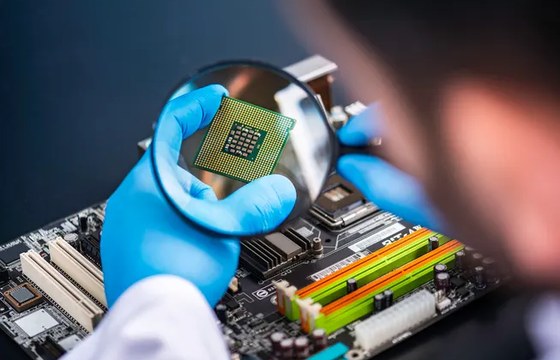
US semiconductor supply chain relies on vulnerable, hidden inputs
www.manufacturingdive.com
Oct. 24, 2026, 4:05 a.m.
The Semiconductor Industry Association released a comprehensive report highlighting critical vulnerabilities in the U.S. semiconductor supply chain and calling for enhanced government-industry collaboration on onshoring and stockpiling initiatives. Semiconductor manufacturing is an intricate, months-long process involving globally distributed specialized materials and equipment networks, with the industry projected to exceed $1.5 trillion in global sales by 2026. The SIA developed a "vulnerability index" evaluating geographic production concentration, exposure to high-risk countries, supplier concentration, and ownership structures, identifying 200 "Tier 1" critical inputs and sub-tier categories across 100 material and equipment categories. While the U.S. domestic and allied suppliers provide approximately 95% of Tier 1 equipment and materials, these suppliers depend on overseas intermediate goods and raw material networks, including rare earth production dominated by China and Russia. Major companies including Micron, GlobalFoundries, TSMC, and Apple have invested significantly in domestic capacity. The report concludes that roughly half of analyzed semiconductor supply categories face high or medium vulnerability, underscoring the urgency for strategic investment to maintain competitiveness in advanced chip development for artificial intelligence and emerging technologies.
Share on

SIA Report Highlights Strategies for Strengthening Supply Chains Supporting the U.S. Chip Ecosystem
www.semiconductors.org
Oct. 24, 2026, 4:05 a.m.
The Semiconductor Industry Association released a comprehensive report titled "Understanding Dependencies in the U.S. Semiconductor Supply Chain," highlighting significant vulnerabilities in the upstream supply chains supporting America's semiconductor ecosystem despite substantial generational investments in domestic capacity. The report emphasizes that maintaining U.S. semiconductor leadership requires coordinated government and industry action to address strategic dependencies and develop trusted supply chains with allied nations. The SIA advocates for targeted supply-side and demand-side policies that encourage domestic supplier expansion and geographic diversification while strengthening partnerships with like-minded international partners. The organization recognizes that transforming and securing supply chains demands sustained, multi-faceted efforts that cannot be achieved quickly. However, the report notes that existing platforms, mechanisms, and tools are available to support this transformation and merely require careful calibration through collaboration between policymakers, industry stakeholders, and the research community. This strategic approach aims to build a more resilient U.S. semiconductor supply chain capable of withstanding future disruptions.
Share on

Internet par satellite : comment ça marche vraiment ?
www.ariase.com
Oct. 24, 2026, 4:05 a.m.
Satellite internet operates through distinct technological approaches that deliver markedly different user experiences. The article examines how satellite connectivity functions, contrasting geostationary satellites, which achieve hundreds of megabits per second but suffer from high latency, with LEO (Low Earth Orbit) constellations like Starlink that combine comparable speeds with significantly lower response times. Performance depends not only on orbital altitude but also on ground infrastructure, radio spectrum allocation, beam capacity, and user density. In France, satellite technology remains niche, with 95.3 percent of premises fiber-accessible as of June 2026. However, its role is evolving beyond connecting remote areas to serve poorly serviced residential properties, secondary residences, and locations requiring independent connectivity. The article explains satellite internet's technical architecture, involving user terminals, orbital satellites, ground gateway stations, fiber optic networks, and Internet presence points. Understanding these distinctions helps consumers determine whether satellite connectivity suits their specific needs or whether terrestrial alternatives like fiber or 5G offer superior implementation simplicity.
Share on

Rivage Investment : un nouveau cycle s’ouvre pour la dette d’infrastructure
www.clubpatrimoine.com
Oct. 24, 2026, 4:03 a.m.
Rivage Investment, a European infrastructure debt specialist, hosted an Investor Day on October 5th to present its market outlook and growth strategy amid evolving European financing needs. European infrastructure debt has demonstrated robust growth, with volumes quadrupling since 2016 at an average annual rate of 15.5%, diversifying beyond renewable energy into data centers and battery storage. Facing structural headwinds—geopolitical fragmentation, public budget constraints, elevated inflation and interest rates, energy security demands, and AI digitalization—Europe requires an additional 750 to 800 billion euros annually in infrastructure investment. Rivage Investment responds by prioritizing assets supporting strategic resilience and energy security while avoiding exposure to fragile supply chains and refinancing risks. The firm emphasizes that essential assets and resilience will drive the next decade of returns with enhanced market volatility protection. The strategy encompasses four focus areas: energy transition, digital and AI infrastructure, municipal services and water, and transportation networks, reflecting the convergence of structural trends toward greater infrastructure needs and constrained public funding.
Share on
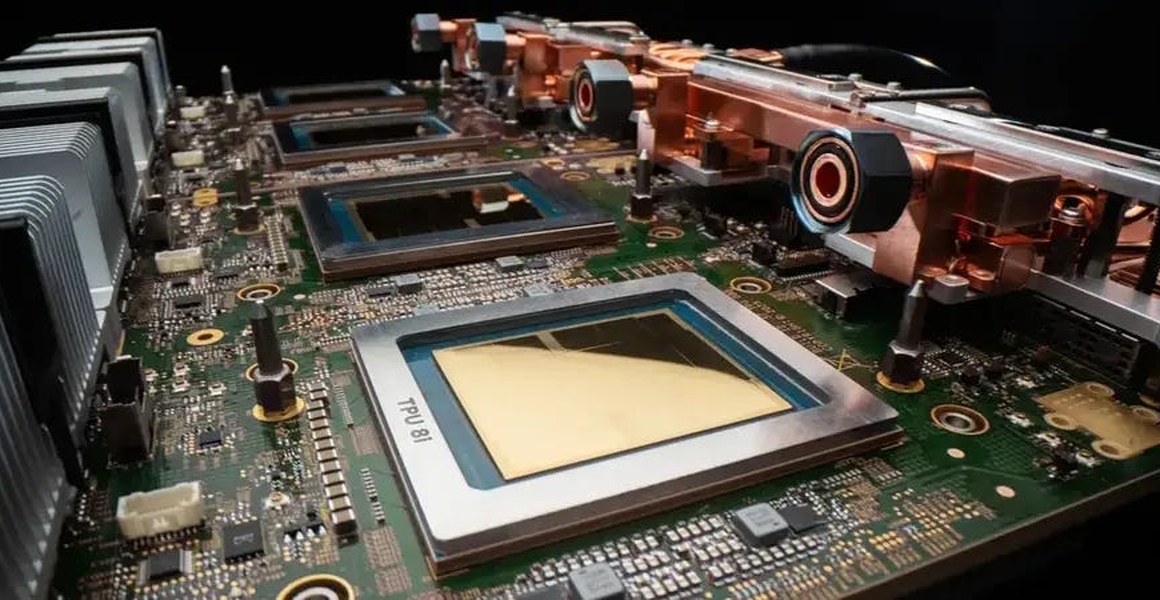
Pour tenir le rythme des investissements, l’IA s’endette à marche forcée
cafetech.substack.com
Oct. 23, 2026, 2 p.m.
C’est un véritable coup de billard à trois bandes, qui illustre à la fois la sophistication de l’ingénierie financière déployée ces derniers mois et l’ampleur de la dette accumulée, à tous les niveaux de l’écosystème, pour financer les investissements colossaux nécessaires au développement de l’intelligence artificielle générative – et, plus précisément, des infrastructures informatiques indispensables à l’entraînement et à l’inférence des modèles et des agents. Une opération qui ne manquera pas de raviver les interrogations sur une possible fuite en avant, alors même que les taux d’intérêt repartent à la hausse.
Share on

Tout comprendre aux levées de fonds des start-up
cafetech.substack.com
Oct. 23, 2026, 2 p.m.
Les levées de fonds ne rythment pas seulement l’histoire d’une start-up. Elles représentent aussi une grande partie de leur existence médiatique. Au-delà des effets d’annonce, il est donc important de comprendre leur mécanisme, du montant levé aux clauses de sortie des investisseurs, en passant par la valorisation et la dilution des fondateurs. Autant de questions, souvent cachées ou présentées sous un jour favorable dans les communiqués de presse, qui engagent l’avenir de l’entreprise. Explications.
Share on

Le jour où le château de cartes de Theranos a commencé à s’effondrer
cafetech.substack.com
Oct. 23, 2026, 1:59 p.m.
“La nouvelle Steve Jobs”. En septembre 2015, le magazine Inc. consacre sa couverture et un portrait dithyrambique à Elizabeth Holmes. Personne ne le sait encore, mais ce sont les derniers instants de gloire pour la fondatrice de Theranos, devenue alors, à 31 ans, la plus jeune milliardaire non héritière au monde. Le 16 octobre, le château de cartes qu’elle a bâti pendant onze ans commence à s’effondrer, à la suite de la publication d’une enquête dévastatrice du Wall Street Journal. Malgré les dénégations, ces révélations emporteront tout sur leur passage, précipitant la chute de l’entrepreneuse et la conduisant jusqu’en prison.
Share on

Des data centers assemblés en orbite par un robot: le pari fou d’Alatyr face à Google et SpaceX
cafetech.substack.com
Oct. 23, 2026, 1:58 p.m.
“Personne ne l’a encore jamais fait”. Emeric Lhomme mesure l’ampleur du défi qu’il s’est lancé avec Alatyr. À la tête de cette start-up française de 11 salariés, cet ancien d’ArianeGroup ne veut pas seulement déployer en orbite des data centers dédiés à l’intelligence artificielle générative, à l’image des projets portés par Google ou encore SpaceX. Il ambitionne d’aller plus loin: assembler dans l’espace, à l’aide d’un robot, plus de 15.000 mètres carrés de panneaux solaires pour alimenter en énergie les GPU chargés d’entraîner ou d’exécuter les modèles d’IA. “Un défi d’ingénierie, mais aussi de financement”, reconnaît-il.
Share on

Researchers mesh electronics with human cells to develop living battery
www.medicaldesignandoutsourcing.com
Oct. 23, 2026, 1:47 p.m.
Researchers at the University of Massachusetts Amherst say they’ve found a way to integrate electronics with human cells in the lab and harvest the natural electricity generated by moving tissue.
Using cardiac cells grown around a thin, flexible, ceramic-and-polymer mesh, the developers described the approach as the start of a reliable source of power that could do away with batteries.
Share on

How a Credit Law Change Boosted Women’s Spending Power
www.library.hbs.edu
Oct. 23, 2026, 11:28 a.m.
For years, lenders restricted credit access to low-earning partners in relationships, but a 2013 law change let them count household earnings, leading couples to spend more without falling behind on payments, according to forthcoming research in the Journal of Political Economy.
Prior to the change, in 41 states, “secondary earners” and stay-at-home parents in a partnership—mostly women—had trouble obtaining much credit because lenders were legally required to judge them on their own income, rather than the larger pool of shared wages couples brought in. That made it hard for these borrowers to independently obtain credit in their own names, often leaving them unable to make important financial decisions, Harvard Business School Assistant Professor Olivia Kim says.
Share on
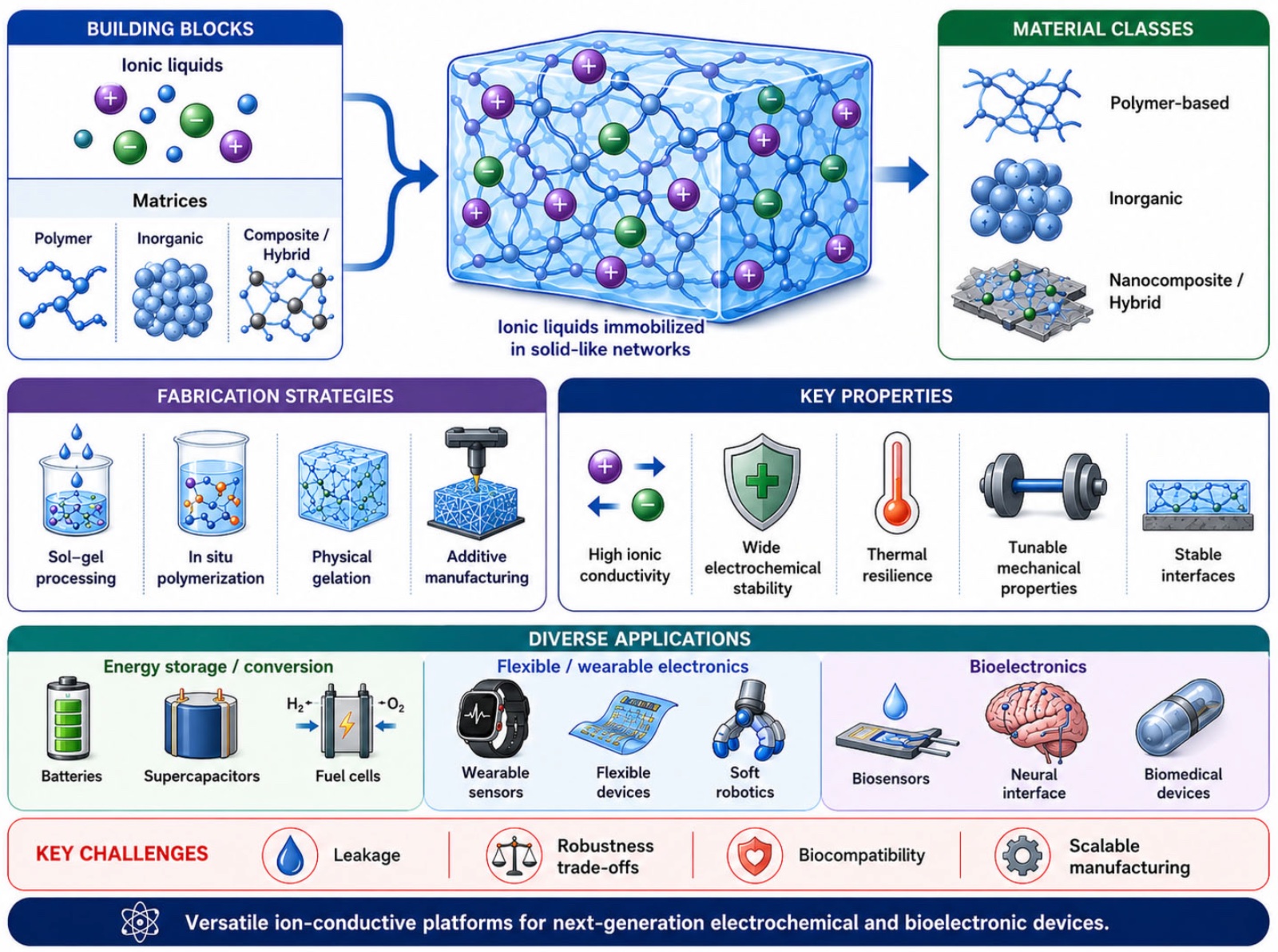
Ionogels: materials design, properties, and emerging applications in advanced electrochemical and bioelectronic systems
www.oaepublish.com
Oct. 22, 2026, 8:45 a.m.
Ionogels are hybrid materials formed by immobilizing ionic liquids within polymeric, inorganic, or composite matrices, combining high ionic conductivity and electrochemical stability with the mechanical integrity of solid-like networks. This review examines the fundamental principles governing ionic liquid confinement and the design of polymer-based, inorganic, and nanocomposite ionogels incorporating fillers such as carbon nanotubes, graphene derivatives, MXenes, and metal nanoparticles. Key fabrication strategies, including sol-gel processing, in situ polymerization, physical gelation, and emerging additive manufacturing, are discussed alongside the resulting physicochemical and electrochemical properties. Particular emphasis is placed on how ionic liquid chemistry, matrix architecture, interfacial interactions, and network structure collectively determine ionic conductivity, electrochemical stability, thermal resilience, mechanical performance, and device-level functionality.
Share on

Why the United States Needs Europe in Order to Win the Technology Race
www.csis.org
Oct. 21, 2026, 1:04 p.m.
The global technology landscape is fracturing as the United States pursues technological dominance while China builds self-sufficiency, creating a strategic competition that increasingly depends on third-party alignment. Europe occupies a critical position in this rivalry, yet its role is jeopardized by the Trump administration's aggressive posture toward the European Union. While Europe has launched multiple technological sovereignty initiatives to reduce U.S. platform dependence, the estimated cost of building an independent technology stack reaches €3.6 trillion. Conversely, the security vulnerabilities of continued reliance on U.S. technology—particularly regarding sensitive government, health, and corporate data stored on servers governed by the CLOUD Act and Foreign Intelligence Surveillance Act—are substantial. The U.S. AI Action Plan explicitly targets global technological dominance through exporting its full AI technology stack to allied nations. However, the administration's adversarial measures toward traditional allies including Europe and Canada are counterproductive, incentivizing these partners to diversify away from American technology toward alternatives, including Chinese solutions. Ultimately, U.S. technological supremacy cannot succeed in isolation; it requires collaborative coproduction with allies. Punitive policies undermine this essential partnership, accelerating technological indigenization and geopolitical realignment contrary to American strategic interests.
Share on
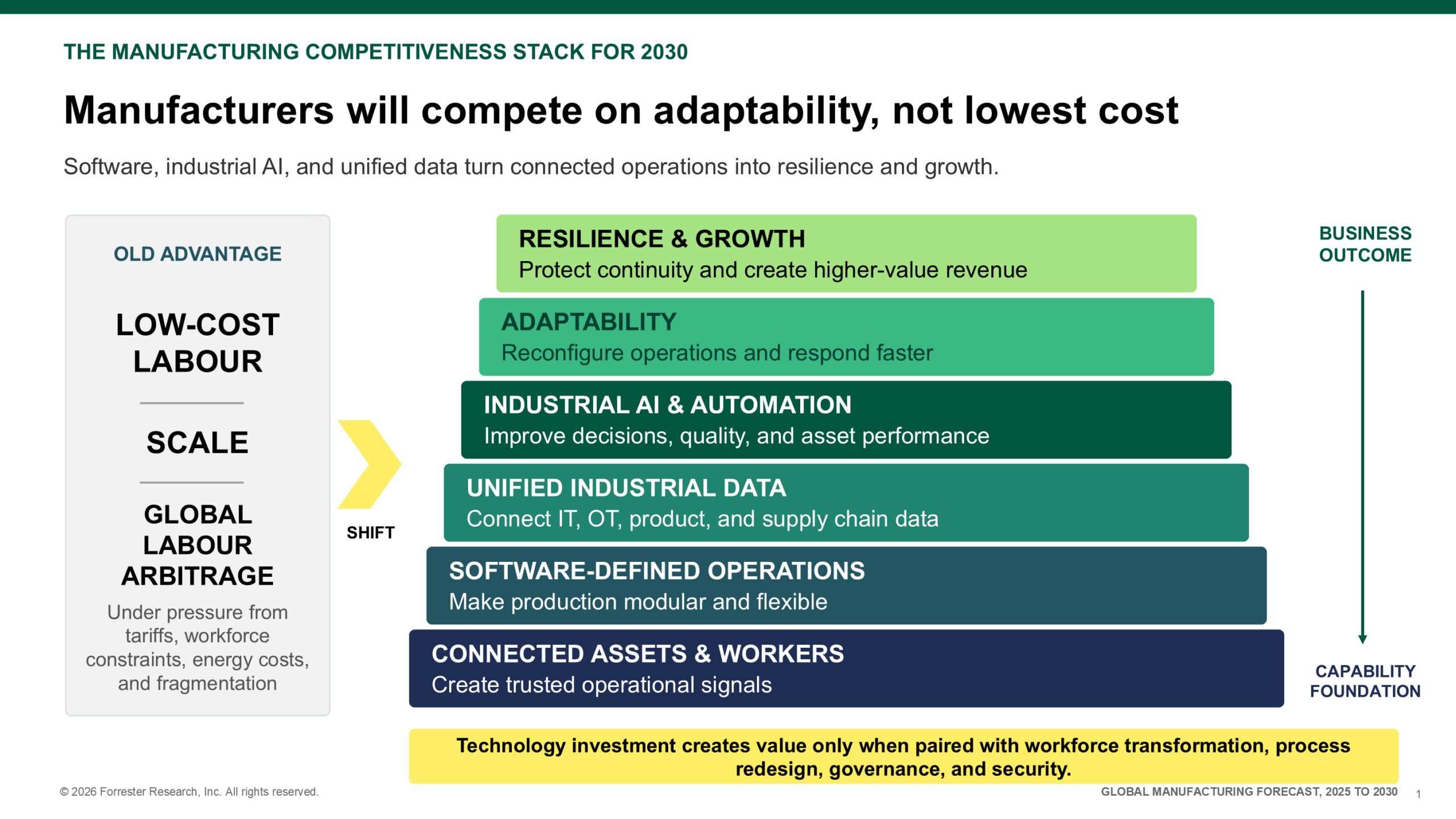
Global Manufacturing’s Software-Led Reset: From Cost Advantage To Adaptive Manufacturing
www.forrester.com
Oct. 21, 2026, 1:04 p.m.
Global manufacturing is undergoing a fundamental transformation driven by tariffs, geopolitical fragmentation, workforce shortages, and rising customer expectations. Traditional competitive advantages rooted in scale, labor arbitrage, and optimized supply chains are eroding, forcing manufacturers to pursue a software-led productivity model. Research from Forrester and colleague Paul Miller reveals that industrial software, long treated as infrastructure, is emerging as a critical competitive differentiator by 2030. Software-defined manufacturing, industrial AI, manufacturing automation, and connected operations enable factories to increase throughput and flexibility while reducing labor dependency—essential as US manufacturing productivity remains below 2017 levels despite significant technology investment. Rather than relocating to lower-cost regions, leading manufacturers are deploying industrial AI, analytics, industrial IoT, and software-defined operations to adapt production rapidly, produce diverse product varieties, and respond to demand variability. This shift from labor-centric to software-centric productivity addresses acute workforce shortages across major manufacturing economies. Manufacturers that outperform through 2030 will not simply invest in technology; they'll fundamentally redesign operations, innovation processes, and change management using smart manufacturing technologies. Forrester projects industrial software will become the fastest-growing manufacturing technology category, capturing significantly larger technology spending shares as software transitions from support function to strategic advantage.
Share on
Quantum 2030
quantumgovernancesystems.com
Oct. 21, 2026, 1:04 p.m.
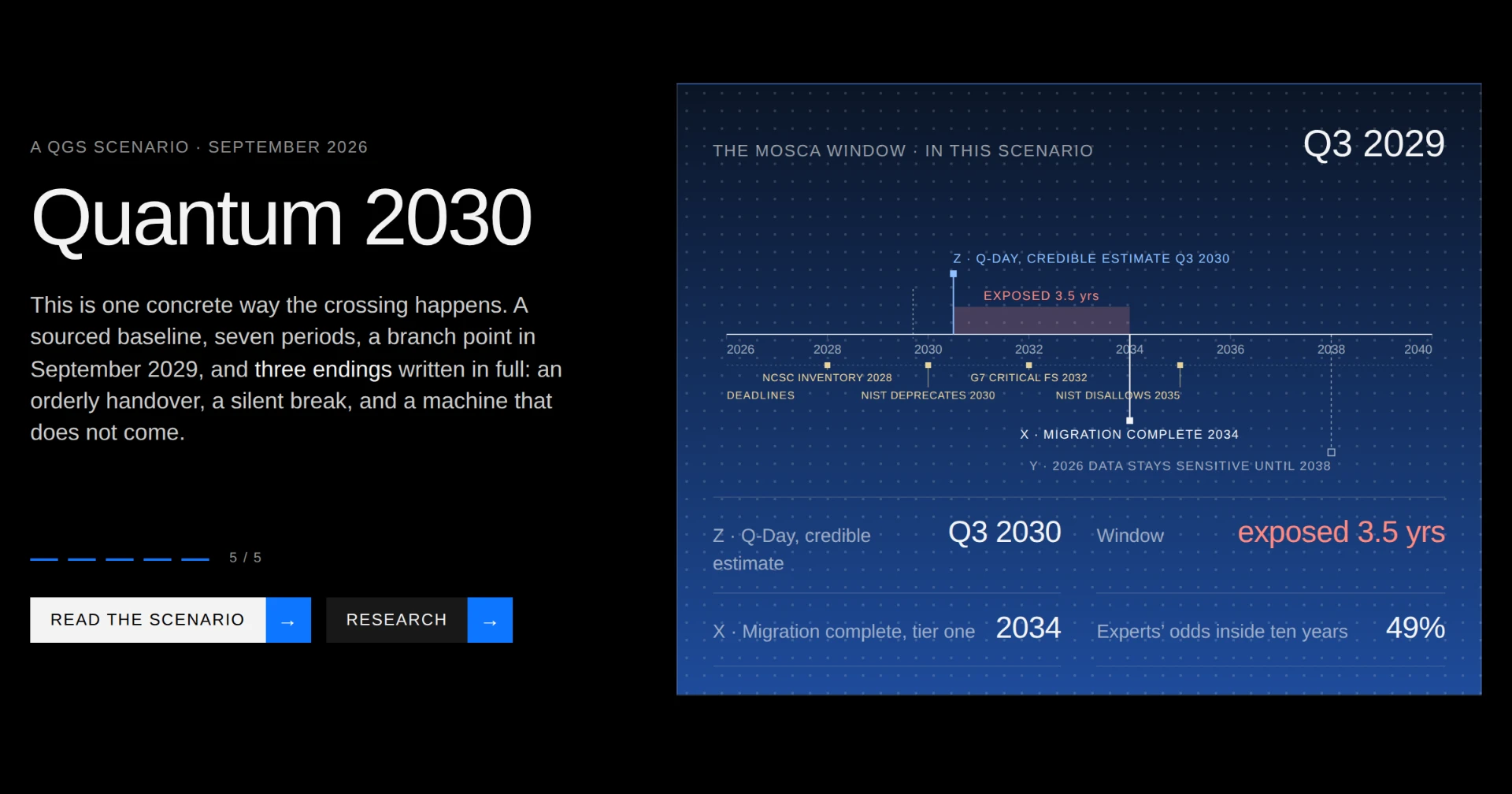
As of September 2026, quantum computing has transitioned from laboratory curiosity to near-commercial reality, creating urgent implications for global cybersecurity. Google's Willow chip demonstrated logical error rates halving with increased code patches in late 2024, while Quantinuum's Helios achieved 48 error-corrected logical qubits commercially since November 2025. IBM's roadmap progresses toward 200 logical qubits by 2029 through its Starling system, and China's Zuchongzhi 3.2 reached below-threshold error correction in December 2025. Quantinuum's June 2026 IPO at $14 billion valuation signaled quantum's emergence as a public-market sector. Critically, cryptographic deadlines now drive urgency: NIST deprecates RSA and elliptic-curve encryption in 2030, disallowing them by 2035. The UK's National Cyber Security Centre demands cryptographic inventories by 2028 and system migration completion by 2035. The Bank of England warns quantum computing could render financial systems' asymmetric cryptography obsolete. The threat follows Mosca's inequality: organizations face "harvest now, decrypt later" attacks where archived ciphertext becomes vulnerable before migration completes, making the cybersecurity deadline earlier than the technology timeline.
Share on

Time to Look Up: Why Space Is Worth Revisiting
temaetfs.com
Oct. 21, 2026, 1:03 p.m.
Recent market pullback in space stocks presents a compelling investment opportunity despite cooling enthusiasm following SpaceX's June IPO. The underlying industry fundamentals remain robust, supported by transformative economic trends. SpaceX's Starship rocket, approaching its fourteenth launch, exemplifies this shift. The company estimates Starship could reduce launch costs to below $100 per kilogram, compared to approximately $2,700 per kilogram for Falcon 9 today—representing a revolutionary step change in launch economics. This cost reduction is coupled with dramatically increased launch cadence, with projections suggesting one mission every two weeks beginning in 2027. These developments unlock substantial demand, with satellite launch volumes potentially growing over 40 percent annually through decade's end. Approximately 40,000 satellites are expected in orbit by then, while SpaceX has filed plans for 100,000 additional Starlink satellites and up to one million satellites for orbital data centers. These projections suggest current forecasts remain conservative. Lower costs and increased launch capacity will drive satellite manufacturing, component demand, launch services, and ground infrastructure expansion across the broader space ecosystem, positioning the space economy for sustained growth driven by powerful secular trends in both commercial and government investment.
Share on

Elle se compare au « microchirurgien » du semi-conducteur : la deeptech Hummink présente Bird, son module industriel testé en Corée du Sud pour réparer les écrans
www.usinenouvelle.com
Oct. 21, 2026, 11:35 a.m.
Inventrice d’une technique d’impression micrométrique capable de réparer les interconnexions électriques en microélectronique, la deeptech Hummink dévoile Bird, son module industriel. Lequel est expérimenté depuis cet été en Corée du Sud, où il s’applique à la réparation de substrats pour les écrans.
Share on

Inside Helsing’s push to reshape Europe’s defense industry
decode39.com
Oct. 17, 2026, 4:04 a.m.
Helsing, a German defense technology startup founded in 2021, is leading a paradigm shift in Europe's defense industry by applying artificial intelligence and software-defined approaches to military operations, mirroring the model established by U.S. companies like Anduril and Palantir. Now employing approximately 1,300 people with offices across Munich, Berlin, London, Paris, and other European cities, Helsing differentiates itself through advanced AI capabilities that enable rapid reconnaissance and strike cycle operations. The company's primary strength lies in building near-real-time situational awareness systems that integrate both proprietary and third-party sensors, presenting actionable intelligence to operators who maintain decision-making authority throughout the targeting process. According to Frank Dirksen, Helsing's chief commercial officer, the company's competitive advantage stems from organizational agility and speed of response to market demands—capabilities that traditional defense contractors struggle to match due to entrenched internal processes. Drawing on operational experience in Ukraine and collaboration with the Bundeswehr, Helsing demonstrates how defense-tech companies can deliver faster innovation cycles than established primes, fundamentally reshaping how European defense industries develop capabilities, set priorities, and partner with armed forces.
Share on

Beyond DeepSeek: China's 2026 model wave and the repricing of the AI stack
www.ssga.com
Oct. 17, 2026, 4:03 a.m.
State Street Global Advisors examines China's artificial intelligence development trajectory beyond DeepSeek, focusing on anticipated model releases expected throughout 2026. The analysis, prepared by researchers Ninghui Liu, Anqi Dong, and Alvin Lau, addresses the broader competitive landscape in AI innovation as Chinese technology companies accelerate their development pipelines. The document explores how multiple Chinese firms are positioning themselves to launch advanced AI models, potentially reshaping the global technology sector dynamics. This matter holds significant importance for institutional investors monitoring geopolitical technology competition and market implications. The communication emphasizes that technology sector investments, particularly in AI-focused companies, carry elevated volatility and capital loss risks due to rapid obsolescence, intense competition for resources and talent, and intellectual property vulnerabilities. The analysis warns that narrowly focused technology investments tend to experience greater price fluctuations than diversified portfolios. As a marketing communication for professional investors, the material does not constitute investment advice and readers are advised to consult financial advisors regarding their specific investment strategies and objectives.
Share on

The New Space Race: How Satellites and Space Infrastructure Could Unlock a Trillion-Dollar Market - Bitrates
www.bitrates.com
Oct. 17, 2026, 4:03 a.m.
The commercial space industry is undergoing a fundamental transformation, shifting from government-funded exploration toward practical satellite-based services for communications, transportation, agriculture, and industrial operations. Rather than focusing on astronauts and distant planets, leading companies increasingly provide recurring revenue through infrastructure and services. This evolution is attracting alternative investors through platforms like Pleasr, who recognize that economic value derives from ordinary satellite applications rather than spectacular launches. However, capturing this opportunity requires understanding the complex value chain connecting satellite operators, infrastructure providers, software developers, and end customers. Critically, satellite value is realized not in orbit but through ground-based software and business operations. A logistics company might use positioning data to optimize delivery routes, while agricultural businesses combine satellite observations with weather data for crop monitoring. This distinction expands the investment landscape significantly—companies need not manufacture spacecraft to participate in the space economy. Instead, value accumulates across antenna developers, data processors, and application builders serving specific industries. The market therefore extends well beyond traditional aerospace manufacturers to businesses offering seemingly ordinary products that integrate satellite capabilities.
Share on

Ambient AI Is Here. Amazon Wants Your Memory.
sebastianbarros.substack.com
Oct. 16, 2026, 1:21 p.m.
Amazon has just introduced two new ambient AI devices under its Bee brand. The concept is pretty simple. You wear a small device on your wrist, clip it to your clothes, or attach it to your smartphone, and it listens to your conversations so you don’t forget important things.
That barbecue you promised your friends next Saturday, the restaurant your wife mentioned three weeks ago, the appointment you made with your doctor, or that bloody report you promised your boss you would send on Friday, which you completely forgot about five minutes after the meeting. Amazon wants to remember those things for you.
Share on