Blue Ocean Strategy Summary: Key Ideas & Lessons
booknomics.com
Oct. 24, 2026, 7:09 a.m.
Blue Ocean Strategy by W. Chan Kim and Renée Mauborgne presents a framework for business competition that moves beyond crowded "red oceans" of direct rivalry toward untapped "blue oceans" created through value innovation. The book introduces several interconnected tools designed to help firms increase buyer value while reducing costs and abandoning industry conventions. Key concepts include the Strategy Canvas, which visualizes competitive factors within an industry; the Four Actions Framework, which guides decisions on what to eliminate, reduce, raise, or create; and the identification of Noncustomers as potential growth sources among those who avoid or reject existing categories. Additional frameworks address Buyer Utility—removing practical obstacles throughout the customer experience—and Strategic Sequencing, ensuring ideas progress through utility, price, cost, and adoption phases. While valuable for challenging conventional business thinking, the framework has important limitations. Competitive advantage cannot be permanently protected, and blue oceans can eventually become red through later competition. The book's utility depends on contextual application rather than formulaic implementation, making it most effective when tested against specific, observable business situations rather than treated as universal strategic doctrine.
Share on

Definition, Benefits, Case Studies, and How to Apply Red Ocean Strategy to Create New Market Space
prasmul-eli.co
Oct. 24, 2026, 7:09 a.m.
Most companies operate in mature, competitive markets rather than creating new ones, necessitating effective Red Ocean Strategy to maintain profitability while competing against numerous similar rivals. Red Ocean Strategy, a concept introduced by W. Chan Kim and Renée Mauborgne, focuses on winning market share within established markets through differentiation, cost efficiency, product quality, customer service, or brand strength. Unlike Blue Ocean Strategy, which creates entirely new market spaces, Red Ocean Strategy addresses competition in clearly defined industries with well-understood competitive rules. Industries such as food and beverage, telecommunications, banking, automotive, and electronics exemplify markets where companies must employ this approach. While intense competition can drive innovation and efficiency, companies risk declining profit margins if they rely solely on price wars or competitor imitation. Success in red ocean markets depends on creating unique competitive positions rather than simply being better than competitors. Michael E. Porter's strategic thinking supports this view, emphasizing that effective strategy involves choosing distinct activities that create unique value propositions. Organizations that understand customer needs deeply and execute differentiation effectively can achieve sustainable growth and profitability despite fierce competition.
Share on

3 vital questions to spur success in corporate innovation: The right to win
www.edb.gov.sg
Oct. 24, 2026, 7:08 a.m.
Corporate innovation ventures often overlook supply chain optimization, despite its critical importance to success. Research reveals that 80 percent of product lifecycle costs are determined during early design stages, and approximately 15 percent of venture failures stem from pricing and cost issues. Unlike traditional startups that prioritize product-market fit, corporate-backed ventures can leverage their parent company's established supplier relationships and procurement expertise to gain substantial competitive advantages. Companies that collaborate closely with suppliers and drive supply chain innovation outperform peers with nearly 2x growth. Two case studies illustrate this approach: an agricultural processing company connected its venture with key suppliers, enabling a digital marketplace that raised $35 million in Series A funding, while a coalition of poultry family offices empowered farmers with new technology, securing $14 million in Series A investment. By combining supplier insights with corporate expertise, technology, and legal capabilities, ventures can access an "unfair advantage" that independent startups struggle to replicate, making supply chain partnership a powerful but underutilized strategy for corporate innovation success.
Share on

Value Co-creation in Service Ecosystems—Investigating the Role of Mediating Modalities Between Structure and Agency in Business-to-business Relations - Schmalenbach Journal of Business Research
link.springer.com
Oct. 24, 2026, 7:07 a.m.
This open-access research article, published in October 2026 in the Schmalenbach Journal of Business Research, examines value co-creation mechanisms within service ecosystems, specifically analyzing how mediating modalities bridge the gap between structural constraints and human agency in business-to-business relationships. The study investigates the complex interplay between organizational structures and individual actors' capabilities in collaborative service environments. By exploring mediating modalities—the tools, processes, and mechanisms that facilitate interaction—the research provides insights into how B2B partners effectively create mutual value despite inherent structural limitations. This investigation matters significantly for practitioners seeking to optimize collaborative frameworks and enhance service delivery efficiency. Understanding these dynamics enables organizations to design more effective partnership models, improve resource allocation, and strengthen value creation outcomes in increasingly complex service ecosystems where multiple stakeholders operate interdependently. The findings contribute valuable theoretical and practical perspectives to business relationship management and collaborative service design.
Share on
Ecosystem Orchestrator - FourWeekMBA
fourweekmba.com
Oct. 24, 2026, 7:07 a.m.
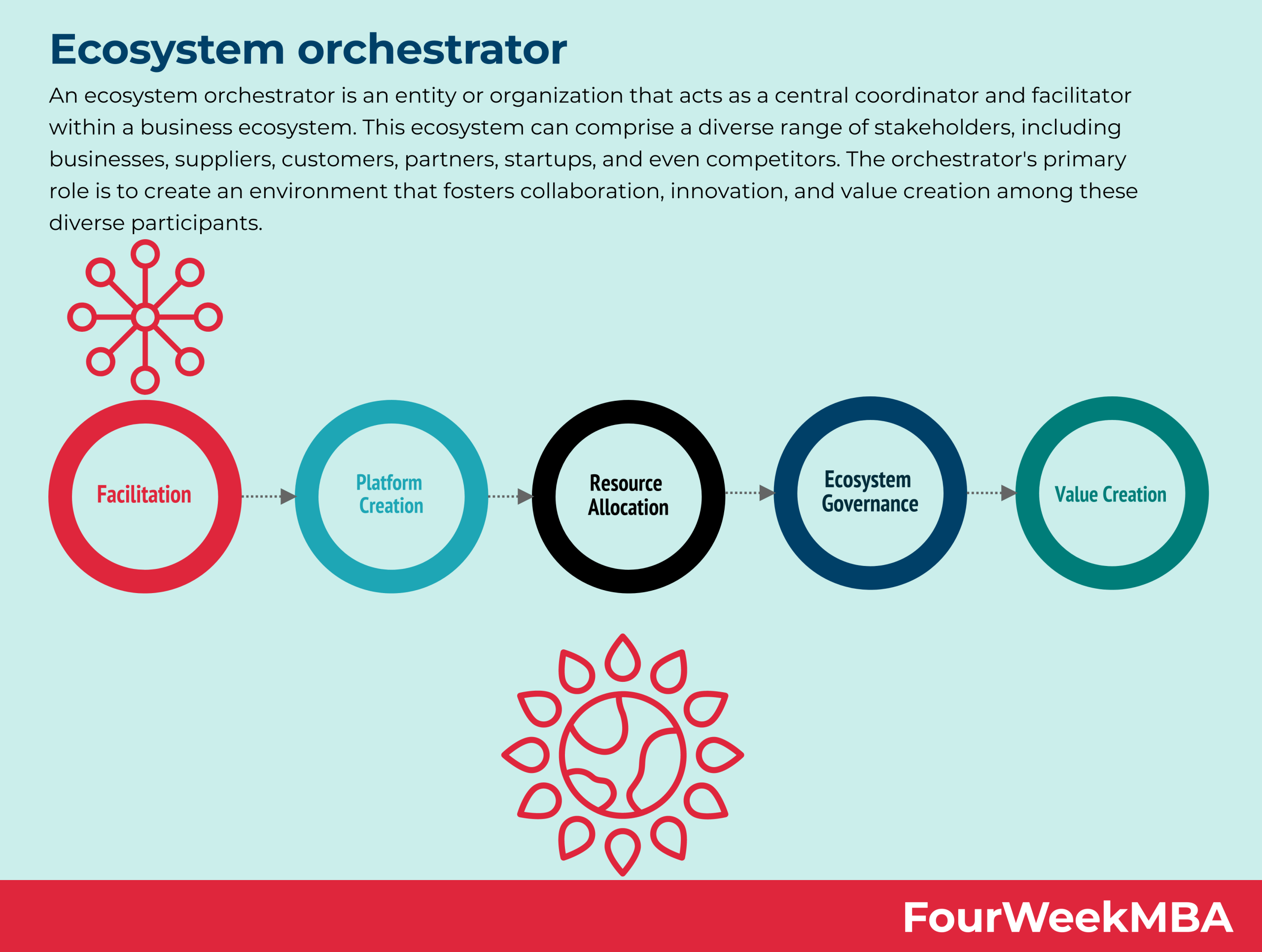
An ecosystem orchestrator creates value by coordinating independent partners, developers, and customers around a shared platform and standardized rules rather than controlling all operations in-house. Drawing on management research by Dhanaraj and Parkhe, and ecosystem theory by Jacobides, Cennamon and Gawer, this model leverages modularity to enable interdependent firms to coordinate without single ownership. Success requires defining interfaces through published standards and APIs, governing network participation and quality standards, balancing incentives so partners remain invested, and maintaining control over scarce core assets like customer access or distribution channels. Real-world applications demonstrate the model's breadth: Anthropic's Model Context Protocol, released in November 2024, established an open standard for connecting AI assistants to data sources and tools, shifting competition to client and server development rather than rule control. The European Commission designated six gatekeepers—Alphabet, Amazon, Apple, ByteDance, Meta, and Microsoft—under the Digital Markets Act, recognizing their orchestration power over app stores and operating systems, now subject to interoperability requirements. Cloud providers further exemplify this approach by offering AI models from multiple labs in unified catalogues with shared billing and security infrastructure. This orchestration model matters because modular AI capability APIs enable single products to combine multiple providers' models, strengthening whoever controls the routing layer.
Share on

A Step-by-Step Guide to Implementing Blue Ocean Strategy in Your Business
www.deepmarketing.it
Oct. 17, 2026, 7:06 a.m.
Blue Ocean Strategy is a business approach developed by INSEAD professors W. Chan Kim and Renée Mauborgne that advocates creating new, uncontested market spaces rather than competing in saturated industries, termed "red oceans." The strategy emphasizes value innovation, simultaneously pursuing differentiation and low cost while expanding market boundaries to capture new demand. This approach proves particularly beneficial for small and medium-sized enterprises that lack resources to compete directly with established players, enabling rapid and profitable growth while avoiding price wars. Grounded in extensive research analyzing over 150 strategic moves across 30 industries spanning 100 years, Blue Ocean Strategy offers a more scientifically validated alternative to earlier positioning concepts. The implementation involves building cross-functional teams, mapping industry value curves against competitor performance factors, identifying non-customers, redesigning the strategy canvas using four key actions, testing at small scale, and launching at full market scale. By systematically identifying underserved market segments and reframing competitive factors, organizations can escape commoditized markets and establish profitable new market spaces where competition becomes irrelevant, fundamentally transforming their growth trajectory.
Share on

Blue Ocean Strategy Explained: Finding Uncontested Market Space
babdirectory.com
Oct. 17, 2026, 7:06 a.m.
Blue Ocean Strategy, developed by Kim and Mauborgne, offers a framework for competing in uncontested market spaces rather than fighting within existing industries. The strategy distinguishes between red oceans, where competitors battle over the same customers with similar offerings, and blue oceans, where companies create new demand through differentiation. The core premise challenges the assumption that industry structures are fixed, arguing that businesses can reshape competitive landscapes by operating on fundamentally different terms. Two practical analytical tools enable this transformation. The first is a two-axis chart mapping industry factors against competitive investment levels; mature industries typically show companies clustered together, indicating red ocean competition. The second involves four strategic questions that guide businesses toward divergence. The author's personal experience demonstrates the concept's effectiveness: by eliminating hourly billing and introducing unlimited revisions on a fixed monthly retainer—offerings competitors lacked—booking requests increased from two to eleven monthly. Blue Ocean Strategy matters because it redirects focus from incremental improvements to creating entirely new market categories, enabling sustainable competitive advantage and margin growth without constant price wars.
Share on

Corporate Venture Building
www.ey.com
Oct. 17, 2026, 7:06 a.m.
Traditional business models face mounting pressure from shifting customer expectations, supply chain disruption, and venture-backed competitors, causing Fortune 500 company lifespans to contract significantly. However, established corporations possess substantial competitive advantages—including strong brands, loyal customer bases, sales infrastructure, and organizational capabilities—that can be strategically repurposed. Corporate venture building enables leadership teams to adopt an entrepreneurial mindset and transform these existing assets into foundations for entirely new business units capable of achieving exponential growth, improving profitability, and scaling toward unicorn status. To succeed, CEOs must abandon incumbent thinking patterns and embrace venture capital methodologies for developing disruptive ventures. EY-Parthenon's Corporate Venture Building framework strategically aligns triggers—market opportunities and catalysts—with corporate endowments to rapidly establish enhanced or entirely new profit-and-loss statements, effectively compressing a traditional growth timeline and achieving meaningful scale from inception.
Share on

3 vital questions to spur success in corporate innovation: The desire to win
www.edb.gov.sg
Oct. 9, 2026, 9:34 a.m.
Corporate innovation success requires three critical disciplines: strategic alignment, priority management, and impact measurement. Organizations must continuously align innovation initiatives with evolving business priorities, as demonstrated dramatically by the Covid-19 pandemic, which shifted corporate focus from customer experience and digital marketing to rapid product adaptation, partnership development, and talent retention. Innovation leaders must actively monitor these shifts and realign their portfolios accordingly, discontinuing projects that no longer deliver strategic value. Additionally, many innovation teams fall into "innovation theatre," emphasizing vanity metrics like workshop counts or customer interviews rather than demonstrating concrete business impact. Effective innovation management requires tailored, impact-driven metrics that vary by innovation type and development stage. Near-core innovations can leverage traditional metrics like profitability and ROI, as existing demand curves and cost structures are well-established. Conversely, early-stage, horizon innovations require stage-specific metrics that highlight potential impact without relying on traditional business measures that may unnecessarily constrain exploratory innovation. Implementing stage-gated processes with appropriate metrics provides business leaders actionable insights necessary for informed decision-making and sustained innovation program support.
Share on
There is a business inside your platform you have not built yet.
aaronallencp.com
Oct. 9, 2026, 9:34 a.m.
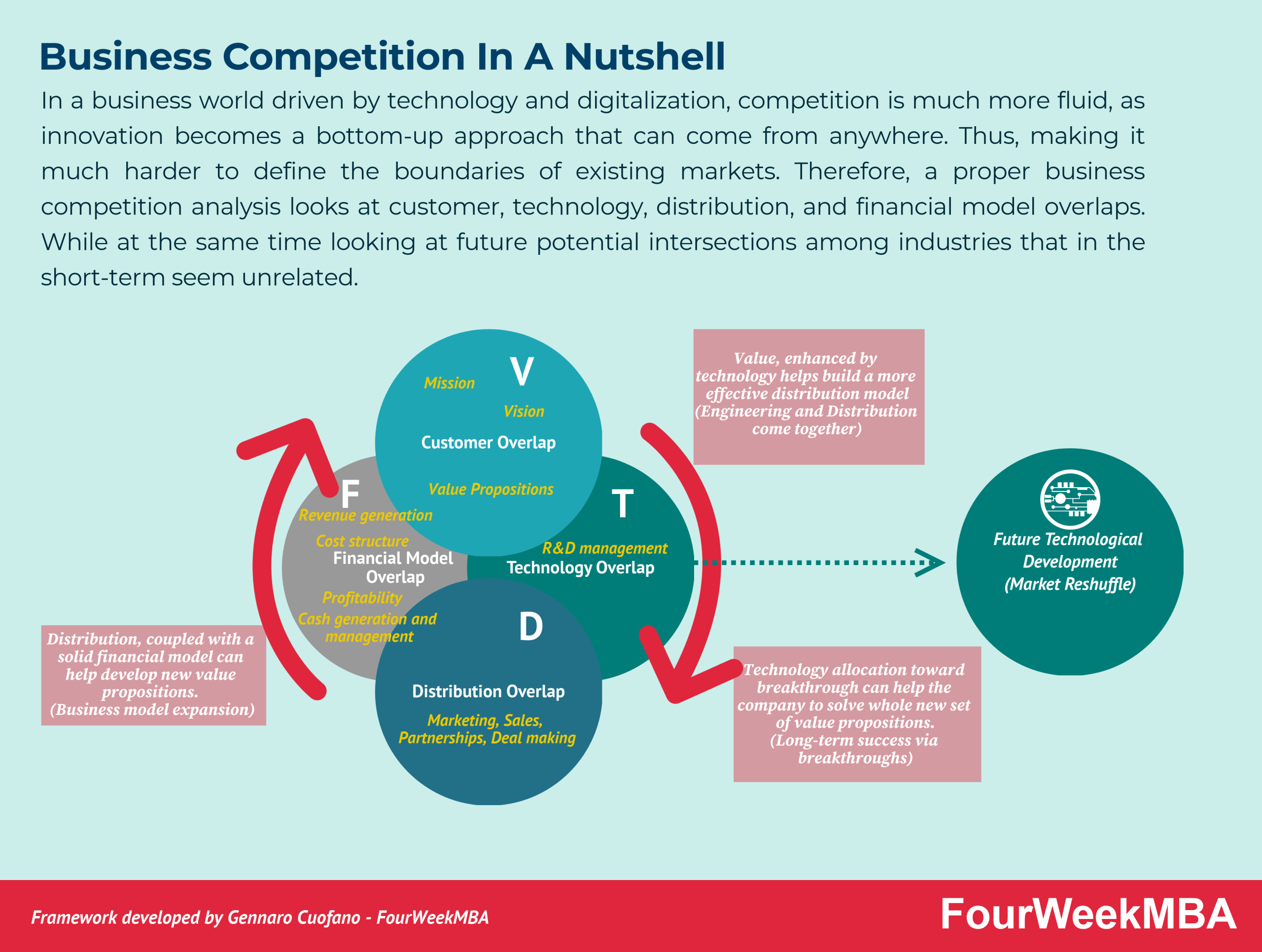
This article examines Corporate Venture Capital and Corporate Venture Capital as a Service (CVCaaS), exploring the strategic framework for corporate venture investments and adjacency opportunities. The piece outlines how to identify secondary value pools within corporate venture strategies, distinguishing between viable and non-viable opportunities. It emphasizes the importance of selecting the appropriate corporate venture function structure to maximize compounding returns. The article clarifies that AACP operates not as a traditional venture fund raising committed capital from limited partners, but rather as an operating and capital architect. Under this model, the principal retains full ownership and decision-making authority while AACP provides strategic guidance and capital architecture. The framework suggests that successful corporate venture engagement requires either a precise strategic fit with an established operating mandate or a rigorous, independent assessment of the platform's potential. This approach underscores the value of thorough diagnostic work regardless of outcome, positioning corporate venture activities as disciplined capital deployment with clear strategic objectives and governance structures.
Share on

How Do You Do a Competitive Analysis That Creates Advantage?
ainna.ai
Oct. 3, 2026, 7:08 a.m.
Competitive analysis is a strategic discipline focused on understanding the competitive landscape to inform better business decisions rather than merely copying rivals. This systematic process involves identifying and evaluating competitors' strengths, weaknesses, strategies, and market positioning. The practice is essential because products operate within competitive ecosystems where they compete for customer attention, adoption, and budget. Effective competitive analysis complements market research—while market research identifies customer needs and opportunity size, competitive analysis reveals who else serves those needs and how effectively. Organizations should monitor four competitor types: direct competitors with similar products, indirect competitors, potential market entrants, and substitutes. While direct competitors warrant detailed scrutiny, potential entrants require vigilant monitoring, and organizations must recognize that the status quo often represents the true competitive threat. Rather than a one-time assessment, competitive analysis functions as a continuous practice, with intensified focus during critical moments such as market entry, major roadmap decisions, pitch preparation, and shifts in win-loss patterns. Successful product teams integrate competitive intelligence into their ongoing strategic framework, enabling data-driven differentiation and market positioning rather than reactive feature development.

Platformization strategy: AI, monetization, and software growth
www.pwc.com
Oct. 3, 2026, 7:07 a.m.
Platformization represents a business transformation imperative for software companies, extending far beyond mere technology adoption. The journey unfolds across three distinct waves that guide organizations from monetization through product evolution to operating model reinvention. Wave 1 focuses on generating momentum by repackaging existing offerings to unlock new monetization opportunities, leveraging AI-enabled capabilities where appropriate to create near-term commercial value without waiting for comprehensive transformation. This approach prioritizes growth alongside cost considerations, departing from traditional models. Wave 2 involves deeper product transformation through re-platforming, requiring leaders to fundamentally reconsider customer objectives and redesign offerings around platform-based architectures. Rather than superficially integrating AI features, this wave emphasizes enabling holistic business outcomes through interconnected platform-enabled experiences. Success hinges on proving and scaling value while overcoming challenges associated with evolving products into sustainable platform-based models. The framework provides leaders with a practical assessment tool to determine current positioning, identify necessary capabilities, and direct investment strategically toward sustained growth and competitive advantage in an increasingly AI-driven landscape.
Share on

Corporate Venture Capital Strategy: The CVC Playbook
leanstartupatelier.com
Oct. 3, 2026, 7:07 a.m.
Corporate Venture Capital has evolved from an experimental initiative to a critical innovation strategy for leading global enterprises. The article presents a comprehensive playbook for executives establishing or optimizing CVC functions, emphasizing that organic R&D alone cannot match market velocity. CVC represents the practice of deploying corporate capital into external early-stage companies to generate dual returns: financial gains and strategic advantages. Unlike traditional venture firms answering solely to limited partners, CVC units must balance financial discipline with parent company strategic objectives. Successful programs operate at the intersection of three core goals: delivering financial returns, providing strategic market insights into emerging technologies and business models, and creating operational pathways including partnerships, pilots, and acquisitions that internal teams cannot develop at comparable speed. The article argues that large corporate innovation efforts often fail due to governance structures designed for predictability rather than exploration. CVC offers structured access to founder-led velocity while providing real-time market intelligence about competitive threats and evolving capabilities, fundamentally shifting how leadership allocates resources and capital toward future opportunity exposure.
Share on

Four Actions Framework: The Complete ERRC Guide with Examples and Template (2026)
vibe.us
Oct. 3, 2026, 7:07 a.m.
The Four Actions Framework is a strategic tool developed by INSEAD professors W. Chan Kim and Renée Mauborgne as part of their Blue Ocean Strategy methodology. Designed to help organizations escape competitive markets by reconstructing value, the framework guides companies through four systematic actions abbreviated as ERRC: Eliminate, Reduce, Raise, and Create. Each action addresses a specific strategic question about which industry factors to remove entirely, scale below standard, elevate above standard, or introduce innovatively. By eliminating undervalued features and reducing over-engineered elements, organizations free resources to redirect toward raising unmet buyer needs and creating entirely new market dimensions. The framework's power lies in applying all four actions simultaneously rather than defaulting to simply adding features or cutting costs. This structured decision model challenges the assumption that industries must compete on identical value dimensions, enabling companies to simultaneously reduce costs while increasing differentiation. Though often misunderstood as a brainstorming exercise, it functions as a rigorous strategic tool for identifying blue ocean opportunities—new market spaces with minimal direct competition—by fundamentally questioning which competitive factors actually matter to customers.
Share on

What is Ecosystem Orchestration?
brandesis.com
Sept. 26, 2026, 7:07 a.m.
Ecosystem orchestration represents the strategic management and coordination of interconnected business entities working toward shared objectives, moving beyond traditional partnership networks. This approach involves actively designing and guiding interactions among diverse participants while understanding their individual roles, capabilities, and motivations. Successful orchestration generates innovation, enhanced customer value, and competitive advantage through clear governance, trust-building, and value-sharing mechanisms. Central orchestrators—typically platform providers or large enterprises—establish rules of engagement, facilitate connections, and create incentive structures that encourage participation. Digital platforms and technologies enable communication, collaboration, and data exchange among ecosystem members. The orchestrator functions as a conductor, ensuring harmonious operation across all components while monitoring market changes and adapting strategies accordingly. This proactive management creates a self-reinforcing cycle where increased participation by one member benefits others, fostering ecosystem growth and long-term sustainability. Effective ecosystem orchestration has become essential for organizations seeking to maintain competitive advantage in increasingly complex, interconnected business environments.
Share on

Four Actions Framework: The Complete ERRC Guide with Examples and Template (2026)
vibe.us
Sept. 26, 2026, 7:06 a.m.
The Four Actions Framework is a strategic tool developed by INSEAD professors W. Chan Kim and Renée Mauborgne as part of Blue Ocean Strategy methodology. Designed to help organizations break free from competitive markets, the framework systematically reconstructs value by guiding decision-making across four dimensions: Eliminate, Reduce, Raise, and Create (ERRC). Rather than functioning as a brainstorming exercise, it operates as a structured decision model addressing the core industry challenge—most markets compete on identical value dimensions, driving up costs without meaningful differentiation. The framework prompts organizations to eliminate industry-assumed features buyers no longer value, reduce over-engineered elements inflating prices, raise factors above industry standards to address unmet needs, and create entirely new offerings to generate demand. The power emerges from employing all four actions simultaneously, as eliminating and reducing actions free resources that raising and creating actions redirect toward genuine differentiation. This approach enables organizations to simultaneously cut costs and increase value, opening new market space with minimal direct competition. This structured approach transforms how companies think strategically about competitive positioning.
Share on

What Does a Chief Innovation Officer Do, and Who Should Lead Innovation?
ainna.ai
Sept. 19, 2026, 7:07 a.m.
A Chief Innovation Officer (CINO) is a C-suite executive reporting directly to the CEO, responsible for enabling enterprise-wide innovation rather than generating it independently. This role is critical for large enterprises facing industry disruption, where innovation is strategically prioritized. The CINO's mandate centers on building organizational innovation capability through systematic processes, tools, and talent development. A 2019 BCG survey revealed that while 80% of innovation executives ranked innovation among their top three priorities, only 30% believed their organizations excelled at it, highlighting the need for dedicated leadership. The CINO must orchestrate the innovation function across divisions, preventing fragmented or ad hoc efforts. The role requires steering three core objectives: enhancing the organization's ability to identify and frame opportunities, strengthening validation of high-potential initiatives, and aligning leadership to invest in and commercialize validated opportunities. Without accountable leadership to design and manage this system, innovation capability fails to compound. The article outlines five organizational models for innovation leadership, each with inherent risks, and provides guidance on assembling the necessary team and measuring success.
Share on

Integrating Innovation: Design Thinking to Business Models
www.coursera.org
Sept. 19, 2026, 7:07 a.m.
Coursera is offering a professional development course titled "Integrating Innovation: Design Thinking to Business Models," currently available at a 40% discount through Coursera Plus. Part of the "Designing the Human Business Specialization" and instructed by Packt, this course teaches participants how to merge Design Thinking methodology with business model innovation to create and scale ventures effectively. The curriculum covers applying Design Thinking principles to develop customer-centric value propositions, translating design insights into actionable business models, and creating go-to-market strategies. Through conceptual frameworks, case studies, and practical assignments, learners gain skills in connecting customer insights directly to business execution while ensuring solutions remain both desirable and scalable. The course emphasizes a holistic innovation approach and includes strategies for sustained competitive advantage in dynamic markets. Completing four assignments over approximately five days, participants will understand how to transform innovative solutions into successful, market-ready offerings. As the third course in a three-part specialization, it provides comprehensive knowledge for professionals seeking to drive organizational growth through human-centered business model design.
Share on
The impact of big data capabilities and business model innovation on new venture performance
journals.plos.org
Sept. 19, 2026, 7:06 a.m.
This empirical study examines how big data capabilities drive new venture performance through business model innovation using a mediation framework grounded in dynamic capability theory. Researchers surveyed 400 Chinese startups operating less than eight years across seven major economic zones, employing SPSS 24.0 and AMOS 24.0 for statistical analysis alongside hierarchical regression and 5,000 bootstrap PROCESS simulations. The findings confirm that big data capabilities significantly enhance venture performance and foster business model innovation, which in turn positively contributes to growth and partially mediates the relationship between data capacity and performance. Robustness tests including median split and outlier removal validated all proposed hypotheses. This research extends dynamic capability theory to digital entrepreneurship within China's emerging market context, revealing the complete transmission chain linking data capabilities to venture growth. The study provides localized empirical evidence for entrepreneurship literature while offering actionable strategies for resource-constrained startups to build competitive advantage through digital upgrading and business model restructuring.
Share on
Beyond the Bloodbath: How to Make Your Competition Irrelevant with Blue Ocean Strategy
www.b2bframeworks.com
Sept. 19, 2026, 7:06 a.m.
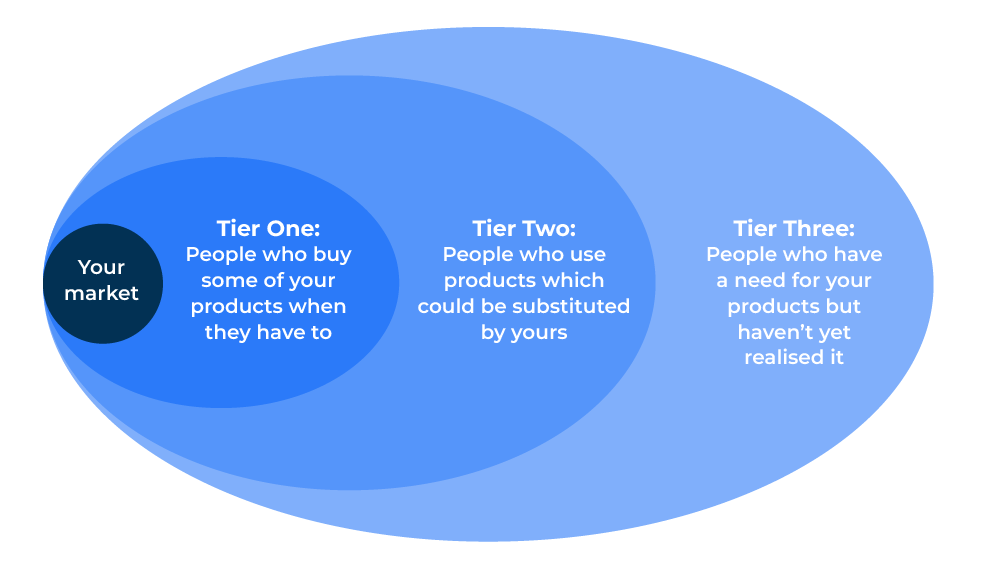
Blue Ocean Strategy offers a transformative approach to innovation by encouraging companies to create uncontested market spaces rather than competing in existing ones. Developed by W. Chan Kim and Renée Mauborgne in their seminal book, this framework contrasts with traditional competition models and complements other approaches like Stage-Gate Process and Lean Startup. The strategy demonstrates potential for three times higher profit margins by making competitors irrelevant through value innovation. Cirque du Soleil exemplifies this approach, eliminating animals and star performers while creating a premium theatrical experience that attracted entirely new adult audiences. The Four Actions Framework guides implementation, asking companies to eliminate industry assumptions, reduce factors below standards, raise competitive factors above standards, and create entirely new offerings. This systematic approach combines innovation with cost reduction to deliver value innovation, fundamentally reshaping market dynamics and customer demand rather than simply improving existing products or services within established markets.
Share on