Fixed Mobile Convergence Is Back, Baby sebastianbarros.substack.com Feb. 1, 2026, 10:06 p.m.
Fixed Mobile Convergence was supposed to be the big unlock a decade ago. One bill, one box, one operator for everything: mobile, broadband, TV, Wi-Fi. It looked clean on paper: quad-play bundles, shared devices, and seamless handoffs from mobile to home Wi-Fi. But it didn’t work. The networks weren’t ready. OSS and billing systems couldn’t talk to each other. Routers were dumb. The phone might drop your call the moment you step out the front door. And the commercial pitch? Mostly discounts. Operators traded ARPU for volume and still experienced churn. By 2015, FMC had disappeared from most boardroom decks.That’s changed.In 2026, FMC is back, and this time it’s not about packaging but all about ambient connectivity, churn reduction, escaping saturation, and focus on ARPA.Mobile growth is flat. Everyone already has a phone. What carriers want now is to own the household. If you take the U.S. as a clear example, there are 130 million broadband-connected homes, each with three to five mobile devices, TVs, speakers, tablets, and laptops. Whoever controls the fixed line controls the entire digital stack inside the house.
Three Giants, Three Wars: US Telco 2026 sebastianbarros.substack.com Feb. 1, 2026, 9:04 p.m.
The United States sets the global benchmark for telecom intensity. With over 300 million connections, deep smartphone saturation, and fiber builds colliding with fixed wireless, it remains the industry’s highest-stakes market. Pricing, retention, spectrum, and infrastructure decisions made here ripple worldwide. To a greater extent, AT&T, Verizon, and T-Mobile set the pace of telecom strategy worldwide.In 2026, these three players seem to be moving in sharply different directions. AT&T scales fiber to lock in convergence. Verizon executes a stripped-down reboot under Dan Schulman, targeting precision over volume. T-Mobile shifts to cash extraction mode, layering dividends and buybacks on top of its subscriber lead, all while pushing enterprise and network slicing into new territory. One market, three models, and a competitive field that leaves no room for mistakes.
Le protocole TrustTunnel masqué d’AdGuard VPN devient open source : l’essentiel à retenir www.servicesmobiles.fr Jan. 31, 2026, 11:02 a.m.
AdGuard VPN a annoncé l’ouverture du code source de TrustTunnel, son protocole masqué conçu pour contourner la censure et protéger la vie privée en ligne. Cette initiative vise à renforcer la transparence et l’innovation dans le domaine des VPN sécurisés.
Telcos and the “Forever Layoffs Syndrome” sebastianbarros.substack.com Jan. 30, 2026, 1:57 p.m.
Telco layoffs dominate headlines these days, yet global employment barely flinches.According to MTN Consulting, total operator headcount reached 4.357 million in 2Q25, down 1.9% year over year, or roughly 84,000 jobs. The quarterly decline averages 18,000 to 22,000 roles, a range that has held remarkably consistent since the early 2010s. The curve did not steepen in 2023. It did not steepen in 2024. It did not steepen after generative AI entered boardrooms.Global telco employment continues to decline at the same pace before and after AI. No cliff, no inflection, just a long, structural decline.
Ericsson vs Nokia: The 2025 Financial Face-Off sebastianbarros.substack.com Jan. 29, 2026, 3:29 p.m.
Ericsson and Nokia are not growth experiments. They are 150-year industrial survivors, built in Nordic economies where capital is scarce, winters are long, and demand cycles are unforgiving. Both companies endured wars, currency resets, technological ruptures, and repeated telecom capital expenditure collapses. Their operating DNA prioritizes balance sheet strength, cost discipline, and endurance over narrative. When markets flatten, their financials become a proxy for the health of the entire telecom equipment industry.That makes the 2025 full-year results quite revealing. Global RAN spending remained flat, operator capex stayed constrained, and pricing pressure intensified. Ericsson exited 2025 with roughly $22 billion in revenue, an operating margin of around 17 percent, $5.8 billion in net cash, and announced $2.3 billion in shareholder distributions. Nokia closed the year with roughly $26 billion in revenue, an operating margin of around 9% reported and 17% on a comparable basis, and $3.7 billion in net cash, supported by Network Infrastructure demand.
5G et satellites : vers une couverture mondiale hybride www.servicesmobiles.fr Jan. 28, 2026, 2:46 p.m.
Depuis des années, les univers des satellites et des réseaux mobiles semblaient évoluer en totale autonomie. Les premiers, jugés coûteux et réservés aux usages spécialisés, bateaux, avions ou zones reculées – paraissaient inaccessibles au quotidien. Quant aux opérateurs mobiles, leur réseau dense n’allait guère au-delà des villes et des villages, laissant de vastes espaces sans aucune connectivité. Deux modèles économiques distincts, deux langages industriels quasi incompatibles… jusqu’à récemment.
Neutralité du Net : l’Arcep alerte sur les risques liés à l’IA www.servicesmobiles.fr Jan. 28, 2026, 2:40 p.m.
Rappelons-le, depuis 2015, le cadre européen garantit à chacun la liberté d’accéder sans discrimination aux contenus et services numériques de son choix. L’Arcep, chargée de veiller à cette application en France depuis 2016, observe que l’essor fulgurant des IA génératives pose aujourd’hui de nouvelles interrogations. Peut-on encore assurer une égalité d’accès pour tous face à des algorithmes qui filtrent, sélectionnent et synthétisent l’information ? Le rapport s’appuie ici sur une cinquantaine d’experts issus de différents horizons – public, privé ou associatif – ainsi que sur des tests menés avec le Pôle d’expertise de la régulation numérique (PEReN). Tous pointent vers un même constat : les conditions mêmes d’ouverture du web se trouvent reconfigurées par ces outils.
Telecom 2026: A Year of Cost Cutting and Grind sebastianbarros.substack.com Jan. 28, 2026, 1:13 p.m.
Most financial analysts frame 2026 as flat-to-low-growth revenues with improving margins. ING anchors the European view: sales growth around 2% and median EBITDA growth around 2.5%, with the spread explained by cost rationalisation rather than a demand step change.After a dip in 2025, analyst models show EBITDA growth rebounding above the four-year median in 2026, reflecting the delayed impact of restructuring, automation, and cost rationalisation programs rather than any improvement in underlying demand or capex intensity. Even that 1.5% to 2% revenue growth is a grind. In many competitive markets, operators fight ongoing high price erosion while discounts and value segment pressure keep ARPU fragile. Penetration is above 100% in most countries, which doesn’t leave room for “new customer growth” but rather forces a sum-zero game. That's an expensive endeavour for the consumer market.Analysts call out exactly that dynamic, with upside coming from bundles and selective price increases, and downside coming from competitive discounting and weak ARPU markets.
(1) Telcos: AI uplink traffic will NOT be a traffic nightmare sebastianbarros.substack.com Jan. 27, 2026, 6:51 p.m.
“Your customer buys AI-powered smart glasses and starts broadcasting life to get real-time intelligence about the world around them. Overnight, it goes viral. 1 billion users adopt the same glasses, the same behavior, the same idea that everything must be streamed in 8K, all the time, every one of the 1,440 minutes in a day. Uplink utilization spikes across the network. Schedulers saturate. Interference explodes as TDD frames fall out of balance. The RAN starts shedding sessions. Then the core begins to unravel. Control plane storms ripple across regions. Latency goes vertical. Cities go dark. Call centers collapse under inbound traffic. Retail stores fill with angry customers. Regulators demand explanations. The board wants answers. You are the CEO and every dashboard is red….”Then you open your eyes and realize it was only a nightmare.
MWC 2026: Your Noise-Canceling Guide sebastianbarros.substack.com Jan. 27, 2026, 6:31 p.m.
MWC is still the center of gravity for global telecom. Nothing else brings this density of operators, vendors, infrastructure players, regulators, and startups into one place. But most of what you’ll hear will be clean slides and recycled messages. Everyone’s transforming. Everyone’s leveraging AI. Everyone’s announcing the future, again.The real value of MWC is what’s not in the press releases. If you listen carefully in back rooms, hallway debates, and during technical deep dives, you can spot the actual shifts shaping the industry. Here are the 12 signals to pick up this year.
WiFi at 40,000 Feet Is No Longer a Joke sebastianbarros.substack.com Jan. 26, 2026, 3:04 p.m.
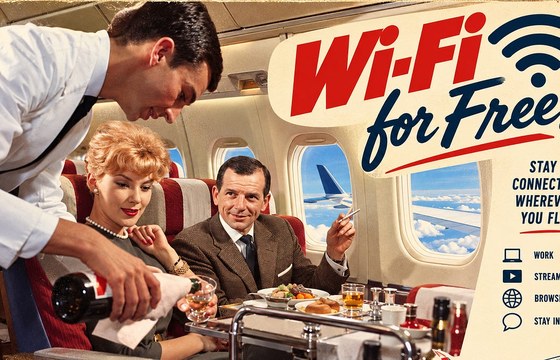
The recent public exchange between Elon Musk and Michael O’Leary over in-flight WiFi was framed as a disagreement about passenger needs. In practice, it revealed a deeper tension between legacy airline economics and a connectivity cost curve that has already shifted. Musk argued from the supply side, where low earth orbit satellite capacity pushes marginal bandwidth costs toward zero. O’Leary argued from the demand side of short-haul travel, where price sensitivity remains extreme, and any additional cost is treated with suspicion. Both positions are internally consistent, yet neither captures the full market reality now forming around in-flight connectivity.
Telcos in Davos 2026: Power, Control, and the End of the Old Telecom Model sebastianbarros.substack.com Jan. 24, 2026, 1:45 p.m.
Davos 2026 marked a clean break for the telecom industry. The industry shifted the discussion away from speed, coverage, and generational labels toward control, autonomy, fragmentation, capital, and geography. Telecom CEOs converged on one reality: Networks are no longer passive infrastructure; they are becoming intelligence systems operating under geopolitical pressure, financial stress, and physical limits. What emerged in the Alps were 5 narratives that will set the roadmap for Telcos in the coming years.
The Most Valuable Telco Brands 2026 sebastianbarros.substack.com Jan. 23, 2026, 1:16 p.m.
For many companies, brand is everything. Just ask Coca-Cola. It sells carbonated sugar water in a market where the product is trivial to copy, yet its brand alone is valued at over USD 100 billion, placing it among the most valuable brands in the world. The value is not in the liquid. It is in the brand’s ability to command trust, habit, and economic permission at global scale.The same logic explains why the top of the Brand Finance Global 500 2026 remains dominated by the same names. Apple leads with a brand value of USD 607.6 billion, followed by Microsoft at USD 565.2 billion, Google at USD 433.1 billion, and Amazon at USD 369.9 billion. More recently, NVIDIA jumped into the global top five, reaching USD 184.3 billion on the back of AI infrastructure demand.That context matters for telecom. Connectivity is regulated, capital-intensive, and largely commoditized, yet a handful of telcos still appear among the world’s most valuable brands while most fade into irrelevance. If brand value reflects future pricing power and strategic freedom, then the 2026 ranking reveals a hard truth: in telecom, brand still matters, but only for those that use it to escape the gravity of pure infrastructure.
AI Frenzy in Telecom: Huawei, Ericsson, or Nokia, Who Wins? sebastianbarros.substack.com Jan. 22, 2026, 12:40 p.m.
AI is no longer an incremental network feature. It is changing how telcos invest, where traffic grows, and which layers of the infrastructure stack capture value. Over the last 12 to 18 months, operators have moved from isolated AI pilots to coordinated investment across mobile access, fixed networks, transport, and automation software. This shift explains why Ericsson, Nokia, and Huawei are no longer pursuing similar strategies.Two forces sit behind this change. First, AI traffic growth is reshaping network topology. Training remains centralized, but inference is spreading toward metro, aggregation, and edge locations. This increases demand not only for mobile capacity, but also for fiber densification, high-capacity IP routing, optical transport, and data center interconnect. In many operator budgets, spending growth in fixed and transport now exceeds incremental macro RAN expansion.
From Telco to AICO: e& Is Assembling a Local AI Infrastructure Network sebastianbarros.substack.com Jan. 21, 2026, 12:29 p.m.
What distinguishes e& Group is not that it talks about AI. Many operators do. It is that it deliberately chose breadth over vertical integration. More than 15 AI-related partnerships were not accumulated accidentally. They were assembled to solve a very specific problem: how to execute AI locally at scale without owning frontier R&D.
India Is the Global Epicenter of 5G, Why? sebastianbarros.substack.com Jan. 20, 2026, 4:33 p.m.
In January 2026, Reliance Jio announced it had surpassed 253 million 5G users, overtaking China Unicom to become the world’s third-largest 5G operator. With over 99% of Indian districts now covered and more than 500,000 active 5G base stations, Jio, along with Airtel and other players, has executed one of the fastest and most expansive 5G rollouts globally. December alone saw over 4,000 new 5G sites added across the country, reinforcing India’s status not just as a large market, but as a full-spectrum 5G deployment case at unprecedented scale.
Telcos Are Dead: Welcome to AICOs sebastianbarros.substack.com Jan. 20, 2026, 11:10 a.m.
Telcos attempted multiple monetization strategies without achieving any change in outcome. Quality tiers, zero rating, sponsored data, and later network slicing promised differentiation but failed to command durable price premiums. Enterprises adopted private networks selectively, yet volumes remained insufficient to move group-level revenue. Latency improvements delivered technical gains but limited willingness to pay, since applications abstracted transport and captured the value layer.Cost per bit continued to fall faster than achievable price increases, driven by silicon scaling, higher-order MIMO, densification, and fiber economics. Transport approached marginal cost behavior while remaining capital-intensive.
Top 10 Telecom Startup Investment Strategies sebastianbarros.substack.com Jan. 17, 2026, 11:25 a.m.
For most of its history, telecom venture capital was symbolic. That changed after 2018 and accelerated sharply after 2022, as tier-one operators and vendors began treating venture investing as a structural tool rather than innovation theater. Competitive pressure, AI-driven compute shifts, and geopolitical risk forced telcos to engage with emerging technology earlier and more deliberately. Today, the ten most relevant telco and vendor-backed venture platforms collectively deploy or manage an estimated $10B to $15B, with annual deployment of roughly $1.5B to $2B. Capital is highly concentrated, and portfolios are tightly scoped around network software, AI infrastructure, cybersecurity, edge compute, silicon adjacencies, private networks, enterprise platforms, and regulated data services rather than consumer growth plays.
AI Agents Are Not Employees! Calling Them That Is Technical Bullcrap. sebastianbarros.substack.com Jan. 16, 2026, 9:51 a.m.
Last week, Bob Sternfels, CEO of McKinsey & Company, stated that the firm has 60,000 employees and that 25,000 of them are AI agents. Not tools or copilots but employees. The wording was deliberate as it places AI agents in the same category as human workers inside an enterprise. That is not a visionary statement; It is a technical bullcrap. Counting AI agents as employees implies equivalence in autonomy, judgment, accountability, and decision ownership. Anyone with a serious background in AI and machine learning knows this equivalence does not exist today, and is not even close to it. What exists are probabilistic systems wrapped in orchestration layers, heavily supervised by humans, brittle under long-horizon execution, and fundamentally incapable of owning outcomes.
Resuscitating Open RAN: Does it Need a Doctor or a Priest? sebastianbarros.substack.com Jan. 14, 2026, 1:41 p.m.
In January 2026, NEC exited global RAN hardware, following Mavenir’s earlier withdrawal from radio units after eliminating $1.3B in debt. Two of the most credible Open RAN challengers have now left the radio layer. Meanwhile, the largest Open RAN deployments are being executed by Ericsson, with Nokia and Samsung dominating the next tier in largely single-vendor configurations. Market concentration has increased rather than declined. Can Open RAN still be repurposed into something that works.