
Elle se compare au « microchirurgien » du semi-conducteur : la deeptech Hummink présente Bird, son module industriel testé en Corée du Sud pour réparer les écrans
www.usinenouvelle.com
Oct. 21, 2026, 11:35 a.m.
Inventrice d’une technique d’impression micrométrique capable de réparer les interconnexions électriques en microélectronique, la deeptech Hummink dévoile Bird, son module industriel. Lequel est expérimenté depuis cet été en Corée du Sud, où il s’applique à la réparation de substrats pour les écrans.
Share on
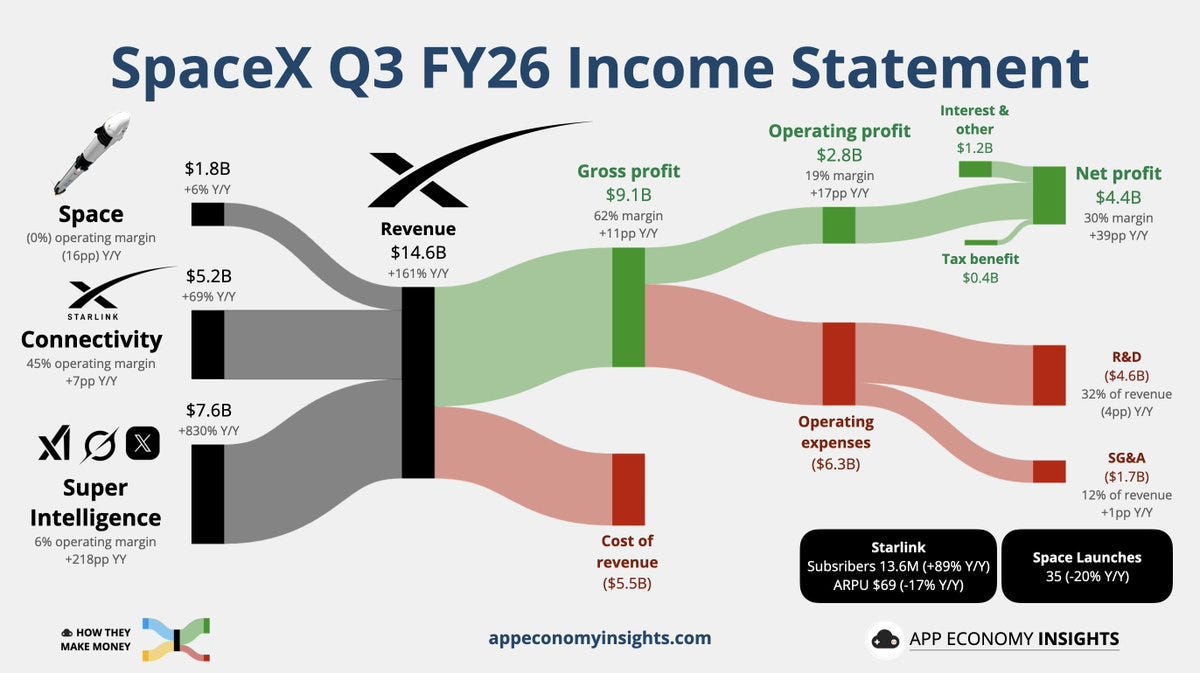
Q3: SpaceX Grew 161%. 10 Things Telcos Need to Understand.
sebastianbarros.substack.com
Oct. 21, 2026, 9:07 a.m.
SpaceX reported $14.6 billion in revenue in the third quarter of 2026, up 161% from the prior year. More revealing is the explosion of the AI business. Its superintelligence division produced most of the growth, while connectivity generated roughly 85% of operating profit. SpaceX is building a business in which rockets lower the cost of connectivity, connectivity brings customers and profits, and compute opens another market.
For the Telecom industry, the question is where that combination shifts control. SpaceX can supply a Telco with coverage while developing the network, applications, and direct customer relationships that could eventually weaken that Telco´s position.
Share on

European Telcos Anticipate the Next Musk-Style Move
sebastianbarros.substack.com
Oct. 20, 2026, 9:06 a.m.
In mobile communications, without spectrum you are nothing. Yes, nothing. You can have the most advanced satellites, billions of dollars, revolutionary antennas and incredible software, but without the legal right to transmit on usable frequencies, you cannot operate a commercial mobile network. You need spectrum that works with the devices you want to connect, in the countries where you want to operate. Otherwise, you need somebody willing to let you use theirs.
Elon Musk understands this very well. Over the past year, SpaceX has moved aggressively to secure spectrum rights, including its approximately $20 billion agreement with EchoStar and, more recently, an agreement to acquire up to 14 MHz of nationwide 800 MHz spectrum in the United States. These are not random investments. They are steps toward a business that could compete with traditional mobile operators without starting with all the infrastructure and legacy obligations of a traditional telco.
Now European operators appear to be learning from what is happening across the Atlantic. On October 19, Deutsche Telekom, Orange, Telefónica and Vodafone announced a joint initiative to explore acquiring satellite spectrum rights across Europe. My interpretation is that they are preparing for the possibility that Musk, or another satellite operator, eventually decides that selling wholesale satellite coverage to telcos is less attractive than taking a larger share of the mobile business.
And this time, the telcos want to be in a position to negotiate.
Share on

The 10 Telco Urban Legends
sebastianbarros.substack.com
Oct. 20, 2026, 9:05 a.m.
Every industry has its urban legends. In telecom, we put ours into PowerPoint presentations, attach a five-year forecast, and ask the board for a few billion dollars. I have spent so many years watching vendors promise that the next technology will bring new revenues, lower costs, and happier shareholders. Operators buy the equipment, deploy the networks, and eventually discover that customers never agreed to the business case. With 6G, AI, satellites, and fiber, some familiar stories are coming back. Here are ten of my favorites, and why I don’t buy them.
Share on
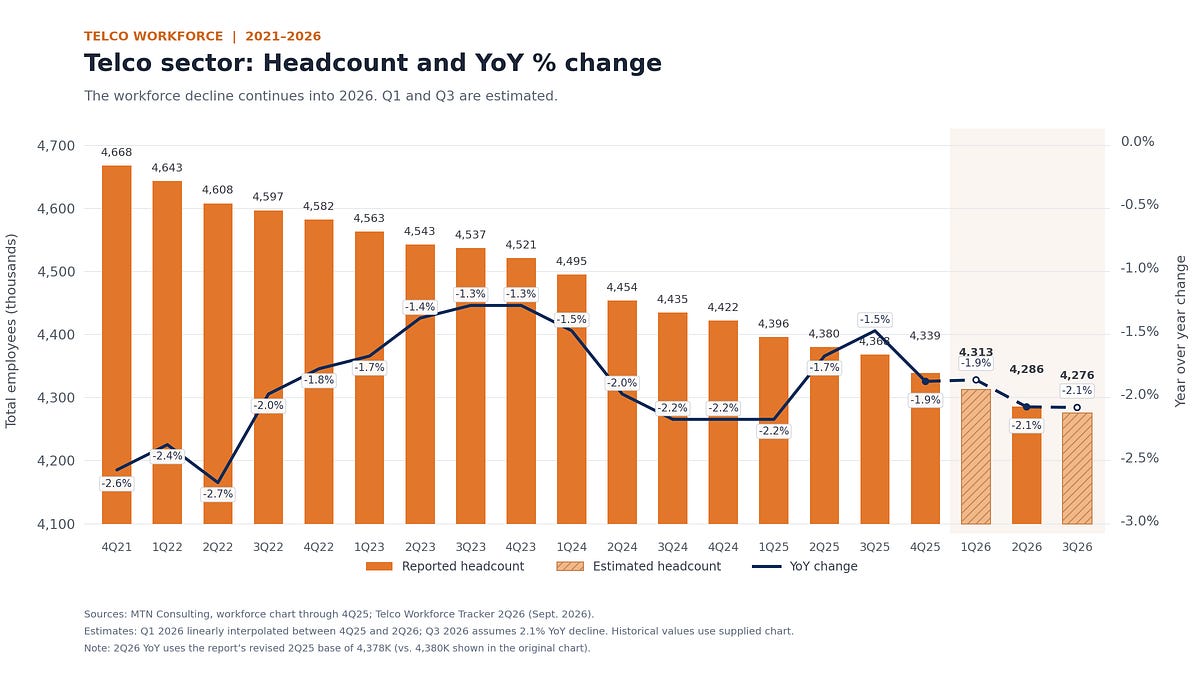
Telcos Were Cutting Jobs Long Before AI. Now AI Gets the Credit.
sebastianbarros.substack.com
Oct. 18, 2026, 2:55 p.m.
Telecom operators have been cutting jobs for decades. As technology evolved, we automated network operations, outsourced field maintenance, consolidated customer care, closed retail stores, and eliminated entire departments. With revenues struggling to grow, reducing the workforce became one of the industry’s favorite ways to protect profitability.
Now we have artificial intelligence, and suddenly the same old strategy has become an AI transformation story. Apparently, reducing employees is no longer just cost-cutting. It is evidence that your company is becoming AI native.
Share on

Voice of Customer for Private Equity
bluwave.net
Oct. 17, 2026, 7:14 a.m.
BluWave, a private equity market network and enablement platform, addresses a critical gap in deal diligence by rapidly connecting PE firms with vetted voice of customer specialists within 24 hours at no upfront cost. Voice of customer research validates investment theses through customer reference interviews, win-loss analysis, NPS surveys, and retention benchmarking, revealing whether target customers will remain loyal, increase spending, and expand purchases—metrics that historical financial data cannot fully capture. The methodology targets high-risk thesis components, including customer concentration analysis to identify accounts at flight risk, competitive win-loss analysis to understand deal dynamics, and pricing research to assess post-close value capture opportunities. Each finding maps directly to underwriting assumptions rather than generic satisfaction metrics. The primary constraint is sourcing sector-knowledgeable interviewers who can identify account fragility and deliver results within compressed two-week diligence windows. Generalist survey firms lack operating nuance, while deal teams' existing networks often lack relevant sector expertise. BluWave's invite-only network comprises specialists with live deal experience in specific verticals, enabling deal teams to pressure-test key accounts and separate viable targets from model-flattered opportunities during both screening and confirmatory diligence phases.
Share on

Investing in the Resource Security Supercycle - Goldman Sachs Asset Management
am.gs.com
Oct. 17, 2026, 7:13 a.m.
The era of assuming low-cost, abundant energy and critical mineral supplies has ended. Geopolitical fragmentation, supply chain vulnerabilities, and surging power demand from artificial intelligence and electrification have triggered a resource security supercycle, elevating access to reliable power and strategic materials to national security priorities. This shift represents a fundamental reorientation of economic policy, moving from decarbonization-focused energy strategies to "all-of-the-above" approaches prioritizing system resilience and energy security. Recent supply shocks—including the 2022 European energy crisis and 2024 disruptions to Strait of Hormuz shipping, a critical chokepoint for twenty percent of global oil—underscore vulnerabilities reminiscent of 1970s disruptions but in a more complex geopolitical environment. This imperative is catalyzing unprecedented capital investment, with global energy spending projected to reach $3.4 trillion in 2026. North America and Europe are executing synchronized infrastructure buildouts driven by rising electricity demand from data centers and manufacturing reshoring. Resource security now constitutes a long-duration investment theme anchored to foundational economic growth, benefiting companies positioned across energy production, critical mineral extraction, and strategic material supply chains.
Share on

How technology diligence strengthens the deal thesis
www.grantthornton.com
Oct. 17, 2026, 7:13 a.m.
Technology diligence in M&A transactions has traditionally focused on identifying risks and confirming system stability, but this approach often fails to address the critical question investors must answer: can the target company's technology ecosystem support the growth and scalability assumptions embedded in the deal model? According to TK Kakar, Grant Thornton Technology M&A Partner, many buyers assess technology merely as a compliance checkbox rather than recognizing it as a strategic driver of deal value. Effective technology diligence requires a value engineering approach that tests technological capabilities against the commercial, operational, and financial outcomes they must enable. This comprehensive evaluation must assess whether the business possesses the necessary technology infrastructure, digital capabilities, data assets, talent, and execution capacity to achieve the underwritten outcomes. A platform may pass traditional diligence and satisfy insurance requirements yet remain fundamentally incapable of supporting the value creation plan justifying the investment. Buyers must therefore shift their lens to evaluate technology as a strategic asset, building evidence-based confidence that the investment thesis is achievable and that required capital investments are accurately reflected in deal models. Ultimately, transaction value depends on whether technology can realistically support growth, margin expansion, and successful execution of the investment strategy.
Share on

The 2026 M&A Report: How Non-AI Companies Win at AI Dealmaking
www.bcg.com
Oct. 17, 2026, 7:13 a.m.
AI has become central to corporate dealmaking, yet companies face critical decisions about whether to acquire AI capabilities or pursue alternative approaches. While the instinct to buy is common, rapidly advancing models and tools risk making acquisitions obsolete or overpriced. A strategic framework evaluates each AI capability along two dimensions: differentiation potential and sourcing accessibility, leading to four moves—adopt, partner, build, or buy. This approach prioritizes securing necessary access while maintaining adaptability over maximizing ownership. Capital markets data reveals that non-technology companies acquiring AI software and applications receive stronger investor response than tech buyers, suggesting greater perceived strategic impact. However, this initial reward reflects investor expectations rather than proven value creation. AI acquisition activity surged across all industry layers in 2025, from hardware infrastructure to software applications, with non-tech companies driving most software and application acquisitions. Simultaneously, alternative deal structures have proliferated significantly, with AI-related alliances more than doubling from 2024 to 2025, exceeding 1,300 new arrangements. These diverse approaches now rival traditional M&A as primary routes to accessing AI capabilities, reflecting a strategic shift toward flexible, multi-faceted engagement models over outright ownership.
Share on
AI Built for M&A | Grata Intelligence
grata.com
Oct. 17, 2026, 7:13 a.m.
Grata Intelligence has introduced Blueflame, an AI-powered M&A agent designed to streamline mergers and acquisitions workflows across the entire deal lifecycle. Blueflame retrieves, reasons, analyzes, and acts on connected M&A data and context, enabling deal teams to execute complex, multi-step transactions more efficiently. The agent integrates market intelligence, firm knowledge, transaction data, deal documents, and evolving deal context to help teams make faster, better-informed decisions. Blueflame supports the full M&A process, from identifying and prioritizing target opportunities through market analysis and competitive landscape assessment, to conducting in-depth due diligence across virtual data rooms and financial materials. The platform generates professional work products including investment committee memos, executive summaries, risk assessments, and board materials. By combining enhanced contextual understanding with greater execution capacity, Blueflame enables deal teams to focus their judgment on high-potential opportunities while automating time-consuming analytical tasks, ultimately improving decision quality and deal outcomes while maintaining human dealmaker judgment at the center of the process.
Share on

By 2030, Humans Will Disappear From the Telco Front Line
sebastianbarros.substack.com
Oct. 13, 2026, 5:36 p.m.
Telcos have spent enormous effort improving customer service, yet something as simple as broken roaming, a billing error, or an eSIM problem can still turn into a nightmare. Customers no longer compare their telco with another telco, but they compare their experience with Amazon, Apple, Uber, their bank, and every other digital service they use every day. Against that benchmark, telecom has a problem.
Share on

The Myth of Human in the Loop
sebastianbarros.substack.com
Oct. 10, 2026, 12:29 p.m.
Sorry to break it to you, but I think we have become a little too obsessed with keeping humans in the loop. Every discussion about autonomous AI eventually reaches the reassuring conclusion that humans will always supervise the important decisions. It sounds responsible, but I suspect we use human supervision to compensate for systems not properly designed for autonomy. My research in AI suggests that humans should increasingly sit at governance, defining objectives, permissions, risks, and operating limits. They should intervene when decisions genuinely exceed the authority already delegated. But requiring human approval during routine execution makes little technical sense, and in customer care and sales, I would argue it can actually make the experience worse.
Share on

China’s Semiconductor Bottlenecks Are Disappearing
www.realcleardefense.com
Oct. 10, 2026, 12:18 p.m.
Beijing is steadily reducing its dependence on foreign suppliers across the broader chip supply chain. That progress is uneven, and some critical gaps will remain for years. Still, the direction is clear. China is building domestic capabilities in the equipment, materials, components and manufacturing processes needed to support a far more self-sufficient semiconductor ecosystem. Missing that key point could become a major strategic setback for the Western tech ecosystem
Our review at Sinolytics examined 20 enabling technologies across the semiconductor supply chain. Three years ago, roughly 60 percent of those technologies were bottlenecks, meaning China lacked substantial domestic capabilities. Today, that share has fallen to about 40 percent. If current trends continue, it could decline to roughly 15 percent within the next three years. The figures are estimates rather than guarantees, but they show how quickly the industrial base is changing.
Share on

15 millions pour 15 000 heures de scanner : Meta finance un vaste projet de modélisation du cerveau humain
www.whatsupdoc-lemag.fr
Oct. 10, 2026, 12:08 p.m.
Dix laboratoires internationaux s'associent pour tenter de modéliser le fonctionnement du cerveau humain grâce à l'intelligence artificielle. Financé à hauteur de 15 millions de dollars par Meta, ce vaste projet prévoit de collecter 15 000 heures d'activité cérébrale, avec l'espoir de faire progresser le diagnostic et le traitement des maladies neurologiques.
Share on

The intelligence advantage: A new playbook for European private equity
www.s-rminform.com
Oct. 9, 2026, 9:42 a.m.
European private equity remains strategically active in 2026 despite challenging macroeconomic conditions, including geopolitical instability, regulatory uncertainty, elevated financing costs, and technological disruption. As outcomes become increasingly unpredictable, investors have raised conviction thresholds and adopted more disciplined approaches centered on deeper intelligence and rigorous underwriting. Effective due diligence and pre-transaction intelligence have become critical competitive advantages for identifying risk, assessing asset quality, and evaluating resilience and value creation pathways. This intelligence-driven discipline extends beyond deal sourcing into active portfolio management, where investors leverage data-driven insights to support operational transformation and mitigate risks. Pitchbook's Q2 2026 European PE Breakdown demonstrates capital concentration on high-quality assets: deal value increased 6.9% quarter-on-quarter while deal count remained flat, and megadeals expanded their share from 32.1% in 2025 to 35% in H1 2026. Europe's robust mid-market pipeline continues generating attractive opportunities, while the private equity market reached a record 2.3 private equity-backed companies per listed company by March 2026, underscoring private capital's structural importance across European economies.
Share on

What Is Agentic AI and How Is It Impacting M&A?
grata.com
Oct. 9, 2026, 9:42 a.m.
Agentic AI represents a transformative shift in mergers and acquisitions, automating workflows that previously required manual assembly by analysts. Unlike generative AI, which responds to individual queries, agentic AI systems execute complete workflows—retrieving company data, reviewing CRM history, comparing targets against investment theses, drafting outreach, and flagging actions for human review. However, the effectiveness of these agents depends heavily on their underlying data layer. Agents powered by verified private market intelligence outperform those relying on generic web research, delivering actionable recommendations grounded in accurate company profiles and transaction history. According to an FT Longitude survey of 1,000 dealmakers conducted in March 2026, AI adoption has become essential: 62% consider human-only decision-making indefensible in complex deals, and 71% believe firms ignoring AI will be unable to compete within five years. As agentic AI absorbs process-heavy tasks, human judgment, trust, and negotiation skills emerge as true differentiators. Notably, 45% of dealmakers believe deal signing should remain entirely human-controlled. This human-AI collaboration creates substantial productivity gains while preserving critical relationship and judgment elements throughout the dealmaking lifecycle.
Share on

AI Due Diligence: The Five-Day Data-Room Workflow (and the Small-Firm Version)
www.llms-for-lawyers.com
Oct. 9, 2026, 9:42 a.m.
AI-powered due diligence platforms are transforming contract review by automating high-volume document extraction—work that language models execute efficiently but that traditionally exhausted junior lawyers. Legora and Harvey, leading vendors in this space, emphasize that AI's primary value lies not in finding issues senior lawyers might miss, but in applying consistent extraction rules across entire contract portfolios. Recent benchmarks from Onit and Vals reveal AI's strengths and limitations: GPT-4-1106 matched senior lawyer performance on determining clause breaches but struggled with precise location identification, while Harvey outperformed lawyers on data extraction and document Q&A but underperformed on redlining and substantive legal judgment. The critical insight is that AI excels at identifying "that" but is weaker at locating "where" and worst at determining "so what." Successful AI due diligence workflows therefore require quoted text and location data for every extraction, reserving judgment calls for human lawyers and prohibiting AI from drafting deal points. Harvey claims this playbook-based approach compresses traditional two-to-three-week reviews into days, though the actual timeline varies by deal complexity and team resources.
Share on

GTM Due Diligence: What It Is and Who Does It [2026 Guide]
gtmdiligence.com
Oct. 9, 2026, 9:41 a.m.
GTM due diligence represents a distinct and increasingly critical assessment category that evaluates whether acquisition targets can actually execute their go-to-market strategy, not merely whether their market is attractive. Unlike traditional commercial due diligence, which examines external market conditions, GTM due diligence conducts an internal assessment of the sales engine, including pipeline integrity, sales productivity, pricing discipline, retention dynamics, revenue operations maturity, and commercial leadership quality. The discipline emerged as a formalized workstream over the past five years in response to private equity firms experiencing repeated post-close revenue shortfalls despite passing conventional financial scrutiny. Deal teams now recognize that companies can operate in growing markets with strong fundamentals yet fail to deliver expected growth due to weak sales execution, inflated pipelines, inadequate CRM hygiene, or poor RevOps infrastructure. As a result, GTM due diligence has evolved from informal questioning into a structured, repeatable standard deliverable. Service providers range from large advisory firms adding GTM capabilities to existing commercial practices, to specialized boutiques focused exclusively on this function, employing methodologies spanning data analytics, CRM analysis, and pipeline stress-testing alongside qualitative interviews with customers, sales representatives, and commercial leadership to validate execution capability.
Share on
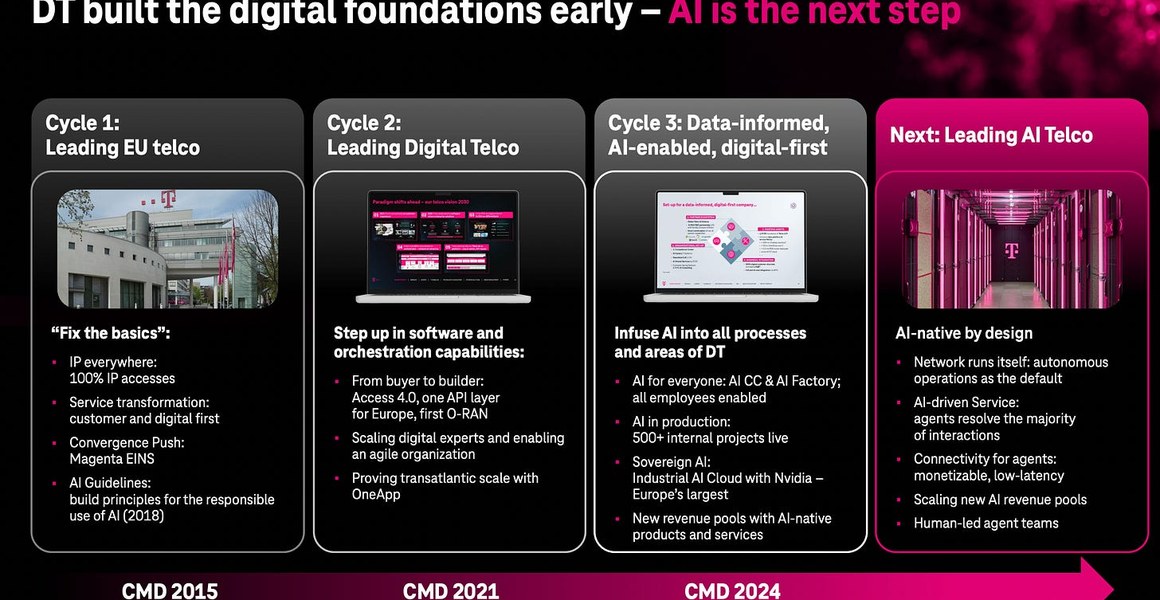
Deutsche Telekom Sees a €5 Billion-a-Year AI Opportunity by 2030
sebastianbarros.substack.com
Oct. 6, 2026, 10:03 a.m.
Deutsche Telekom held its AI Investor Day this week, and it was one of the more interesting attempts I have seen from a telecom operator to explain what AI could actually mean for the industry. Most telcos still talk about AI through customer-service bots, coding copilots, and a collection of isolated use cases. DT presented something much broader: AI as an enterprise redesign that touches the network, customer interaction, software, infrastructure, and eventually the products the company sells. It is difficult to argue that many operators are further along in putting all those pieces together.
Share on

Bad Wi-Fi Could Now Cost an Airline CEO His Job
sebastianbarros.substack.com
Oct. 4, 2026, 4:05 p.m.
For years, passengers tolerated terrible in-flight internet. You paid twenty dollars, opened Gmail, waited, tried again, and eventually gave up. Nobody expected to hold a video call halfway across the Atlantic or work normally from a laptop for six hours. That is changing because the underlying technology has changed. Emirates now has A380 with more than 2 Gbps of aggregate Starlink capacity across the aircraft, while its first generation of A380 connectivity had less than 1 Mbps available for the whole plane.
Share on