
How Behavioral Science Supports Climate Action: Interventions That Turn Intent Into Measurable Change
thedecisionlab.com
Oct. 24, 2026, 7:33 a.m.
A comprehensive survey of nearly 130,000 people across 125 countries, published in Nature Climate Change by researchers Andre, Boneva, Chopra, and Falk, reveals a significant gap between climate action intentions and behavior. While approximately 70 percent of respondents indicated willingness to donate 1 percent of household income monthly to combat climate change, they estimated only 40 percent of their peers would do likewise. Behavioral science addresses this intention-action gap by redesigning decision environments through defaults, social norms, incentives, timely prompts, and simplified choices. The Decision Lab applies these principles across real-world projects, from assisting Rome's diesel vehicle ban to encouraging reusable cup adoption at major coffee chains. The Intergovernmental Panel on Climate Change projects that demand-side behavioral changes could reduce greenhouse gas emissions by 40 to 70 percent by 2050 in buildings and transportation sectors. Effective climate programs measure actual behaviors—energy consumption, travel patterns, purchasing decisions—rather than relying solely on attitudes. Behavioral interventions work optimally when targeting specific decision barriers alongside complementary policies and infrastructure, amplifying rather than replacing traditional climate solutions.
Share on

An Explainable Web-Based Model to Identify Dark Pattern
jaiet.com
Oct. 24, 2026, 7:33 a.m.
Researchers have developed an explainable web-based model designed to identify and combat dark patterns—deceptive user interface design techniques that manipulate user behavior on digital platforms. Dark patterns are increasingly prevalent in e-commerce, social media, and other online services, where they exploit cognitive biases to encourage unwanted actions such as unnecessary purchases or privacy violations. This study presents a machine learning approach that not only detects dark patterns with high accuracy but also provides transparent explanations for its classifications, addressing a critical gap in digital consumer protection. By analyzing visual and textual elements of web interfaces, the model can identify common dark pattern types including misdirection, hidden costs, and confirmshaming. The explainability component is particularly significant, as it enables stakeholders—including platform designers, regulators, and consumers—to understand why specific interface elements are flagged as problematic. This work matters substantially for protecting online users from manipulation while helping legitimate businesses design ethical interfaces and supporting regulatory enforcement efforts in the digital marketplace.
Share on

Recommendations for the Digital Fairness Act: Wellbeing and Vulnerability (beyond money and manipulation)
resocialproject.nl
Oct. 24, 2026, 7:33 a.m.
The European Union's forthcoming Digital Fairness Act should extend beyond traditional consumer protections to safeguard users' time, attention, autonomy, and wellbeing on social media platforms. The RESOCIAL research project, an interdisciplinary initiative funded by the Dutch Research Council and conducted by Leiden University, TU Delft, the University of Twente, and Inholland University of Applied Sciences, examined how platform design features affect user vulnerability. Through legal analysis, human-computer interaction research, design studies, and empirical investigation including large-scale surveys and stakeholder workshops, researchers found that features like infinite scrolling, autoplay, persistent notifications, and personalized recommender systems—designed to maximize engagement—can undermine user control and wellbeing without causing direct financial harm. The project reveals that vulnerability is not merely an individual trait but can be created or amplified by platform design and power imbalances between users and companies. This challenges conventional consumer law approaches that typically identify vulnerability with specific demographic groups. The research argues for regulatory frameworks that address vulnerability more broadly, recognizing how platform design choices exploit user dependencies and prioritize engagement over user interests.
Share on

A theory-guided model maps four recurrent modes of fear-goal arbitration across learning and relapse in rats
elifesciences.org
Oct. 24, 2026, 7:32 a.m.
Researchers applied a hidden Markov model to analyze fear extinction in male rats, examining whether reduced defensive behavior represents true recovery or merely suppressed responding. The study tracked 29 animals across 213 sessions, analyzing 47,004 five-second behavioral windows using freezing, ultrasonic vocalizations at 22- and 50-kHz frequencies, and lever pressing for food. Building on tri-reference-point theory from risky choice research, the team identified four distinct behavioral modes: Fear/Danger, Quiescent, Exploratory, and Goal-directed states. The theory-guided model revealed that while fear-conditioning shifted behavior toward Fear/Danger dominance, extinction reduced this mode to 2.7% by the final phase. However, Quiescent behavior occupied 95.8% of time with minimal Exploratory (0.6%) or Goal-directed (1.0%) activity—indicating fear suppression without functional restoration. The findings suggest fear extinction alone does not restore normal exploration and goal-pursuit behaviors essential for genuine recovery. This computational approach distinguishes between defensive behavior reduction and comprehensive behavioral restoration, with implications for understanding relapse vulnerability and designing more effective anxiety disorder treatments.
Share on

When Should Research Move From Efficacy to Implementation?
manuelgarcia.info
Oct. 24, 2026, 7:32 a.m.
Research should transition from efficacy studies to implementation research when evidence of an intervention's benefits becomes sufficiently credible to justify examining real-world adoption and delivery, rather than waiting for perfect evidence. While efficacy research tests interventions under controlled conditions to isolate their true effects, effectiveness research examines outcomes in routine practice settings with broader populations and less experimental control. The critical challenge lies in timing this transition appropriately. Moving toward implementation too early risks disseminating interventions with uncertain benefits, while delaying indefinitely postpones learning whether interventions can function outside laboratory conditions. Implementation research addresses distinct questions about adoption, feasibility, fidelity, reach, cost, and sustainability—research questions in their own right, not merely logistical concerns. Hybrid research designs can deliberately study both effectiveness and implementation simultaneously when evidence and research context support this approach. Efficacy and effectiveness exist on a continuum rather than as separate categories, and this transition can occur before all effectiveness research is complete, enabling researchers to simultaneously address whether interventions work and how they can be successfully sustained in practice.
Share on

The right to a healthy online environment: Corporate food advertising, digital platform regulation and algorithmic determinants of health
policyreview.info
Oct. 17, 2026, 7:26 a.m.
Recent regulatory developments have empowered authorities to combat clearly harmful online content, yet platforms' responsibility for health-demoting material remains largely unaddressed. This paper examines how digital platforms create advertising environments promoting unhealthy diets through algorithmic mechanisms, framing this as an "algorithmic determinant of health." The authors propose a human rights-based approach to digital platform regulation, requiring both governments and platforms to protect individuals from health-demoting food marketing content. Upon reviewing policies across twelve major advertiser-funded platforms, they conclude existing frameworks fail to meet human rights obligations. While the UK Online Safety Act and EU Digital Services Act represent progress in platform governance, the authors argue these measures are insufficient. A digital duty of care, exemplified by the EU Digital Services Act, offers a more promising regulatory model. Though focused on food marketing, this human rights framework extends to other health-demoting content including gambling and alcohol advertising, highlighting the critical need for comprehensive digital platform accountability as commercial interests increasingly influence public health outcomes.
Share on

Glossary of Behavioral Strategy Terms
behavioralstrategy.com
Oct. 17, 2026, 7:26 a.m.
This glossary defines essential behavioral strategy terms used by practitioners to analyze and influence behavior change. The framework centers on core metrics including Δ-B, TTFB, behavior retention at decision-relevant intervals, and bPMF, alongside the Chain Risk Score for adoption-chain mapping. The Behavioral State Model serves as a diagnostic tool comprising six Personal Components—Personality, Perception, Emotions, Abilities, Social Status/Situation, and Motivations—plus two Context Components covering Social and Physical Environments. Importantly, this model functions as a practitioner diagnostic aid rather than a validated psychometric instrument. The Behavior Fit Assessment compares candidate behaviors across Dispositional, Capability, and Context Fit dimensions, using a minimum score of six out of ten as a calibration threshold. The Four-Fit validation hierarchy guides sequential investment decisions through Problem Market Fit, Behavior Market Fit, Solution Market Fit, and Product Market Fit stages. Each stage involves specific validation criteria, with common mistakes including assuming problems exist without user demand validation or selecting behaviors based on assumptions rather than observation. These tools collectively enable practitioners to systematically assess behavioral feasibility and market viability before resource commitment.
Share on

UW Research Category: Implementation Outcomes - Implementation Science at UW
impsciuw.org
Oct. 17, 2026, 7:25 a.m.
University of Washington researchers are investigating implementation outcomes—the critical bridge between evidence-based research and real-world clinical practice. This framework addresses how interventions successfully reach their intended populations, which is essential for advancing health equity. The research identifies several key dimensions of effective implementation: identifying which implementation strategies perform optimally in practical settings, optimizing resource allocation by assessing feasibility and costs, tailoring approaches to specific contexts, and enabling continuous quality improvement through fidelity and penetration monitoring. The study emphasizes acceptability as a core implementation construct, defined as stakeholders' perception that a treatment, service, or innovation is agreeable and satisfactory. Acceptability differs from general service satisfaction; it specifically evaluates particular treatments based on dimensions like content, complexity, and comfort. The research highlights that even evidence-based interventions fail without effective implementation. By systematically studying implementation outcomes, policymakers gain actionable insights for scaling interventions and driving policy changes, ultimately ensuring that proven health solutions translate into tangible improvements in practice and health equity outcomes.
Share on

AI-Driven Urge Regulation Assistant (AURA): Designing Preemptive Smart Wearables for Smoking Cessation
arxiv.org
Oct. 17, 2026, 7:25 a.m.
Smoking cessation represents a significant public health challenge, with smoking remaining the leading cause of preventable death and disease globally, costing approximately $1.4 trillion annually. Existing wearable cessation systems primarily operate reactively, detecting smoking lapses only after they occur and missing critical intervention windows. Researchers developed AURA (AI-Driven Urge Regulation Assistant), a novel smartwatch-smartphone ecosystem designed to shift from retrospective feedback toward proactive craving management. Guided by cue-reactivity theory and Self-Determination Theory, the team conducted a formative pilot qualitative study with ten smokers and ex-smokers from underrepresented multi-ethnic Asian populations, using semi-structured interviews and iterative co-design processes. Key findings identified craving predictors across habitual, emotional, and social dimensions, with participants preferring intervention strategies including social accountability, personalized support, rewards, and just-in-time distraction techniques. Users emphasized the importance of trust, privacy, personalization, and non-judgmental interactions. These insights directly informed AURA's design, which leverages commercially available wearable devices to enable timely interventions before cravings lead to lapses, supporting user autonomy and competence while addressing a critical gap in current digital health solutions for smoking cessation.
Share on

What Is Fairness-By-Design? Definition & Examples
nhimg.org
Oct. 17, 2026, 7:24 a.m.
Fairness-by-design is a product and ethics principle that ensures users can genuinely understand, compare, and freely choose options without hidden pressure or manipulation. Rather than merely appearing unbiased, it structures the entire user experience through deliberate choices in information ordering, labeling, layout, disclosure timing, wording, and defaults. The approach proves critical in high-stakes moments such as consent screens, plan comparisons, and checkout flows where users face nudging risks. Neutral interaction design avoids selective emphasis, confusing asymmetry, or unnecessary friction that pushes users toward predetermined outcomes. Effective fairness-by-design requires clear information architecture that prevents relevant information from being buried or fragmented, plain language, consistent labeling, and defaults that do not covertly steer behavior. Beyond product design, fairness-by-design carries significant security and governance implications, as manipulative flows undermine informed consent and create trust gaps. Regulators increasingly treat unfair choice architectures and dark patterns as risk issues affecting transparency and user autonomy. Frameworks like the EU Cyber Resilience Act and CISA Secure by Design reinforce expectations that digital products reduce avoidable harm rather than create it through misleading defaults, making fairness-by-design essential for protecting user intent and preventing coerced consent.
Share on

Plant-Based Nudge Calculator
www.betterfoodfoundation.org
Oct. 9, 2026, 9:53 a.m.
A Plant-Based Nudge Calculator has been developed to help food service operators estimate the impact of shifting diners toward plant-based meals. Users input basic operational data—meals served daily, annual operating days, and customer volume—then select one of five evidence-based nudging strategies to project outcomes. The calculator estimates how many meals could transition from animal-based to plant-based annually and quantifies associated carbon emissions avoided, which can then be converted into tangible environmental metrics using the EPA's Greenhouse Gas Equivalencies Calculator.
The five nudges evaluated include making plant-based options the default while keeping animal products available upon request, establishing a 2:1 ratio favoring plant-based proteins, using prime placement for plant-based items, making subtle ingredient substitutions, and optimizing menu descriptions. Each approach draws from peer-reviewed research and field trials. Notably, implementing these strategies typically reduces costs rather than increasing them. NYC Health + Hospitals saved approximately $0.59 per meal by defaulting to plant-based options, yielding $470,000 in annual savings, while a London university caterer found plant-based recipes cost 30 percent less per portion than meat alternatives. The calculator accommodates both single events and ongoing operations, making it accessible for various dining contexts seeking to advance sustainable food systems.
Share on

Nudge - CX Knowledge Database
www.ux-strategy.ch
Oct. 9, 2026, 9:52 a.m.
# Professional Summary
Choice architecture—the way options are presented—profoundly influences decision-making outcomes, often more effectively than persuasion or additional information. Research by Eric Johnson and Daniel Goldstein in 2003 revealed striking disparities in European organ donation rates: Germany's opt-in system achieved 12% consent, while Austria's opt-out system reached 99.98%, despite nearly identical cultural and medical contexts. In controlled experiments with 161 subjects, opt-in garnered 42% participation versus 82% for opt-out among identical populations, demonstrating that default settings dramatically shape choices without restricting freedom.
A 2012 field experiment by Collin Payne and Christina Roberto in a US high school cafeteria further validated this principle. Simply repositioning chocolate milk behind regular milk increased regular milk selection from 18% to 48%. Moving chocolate milk to a separate, less visible cooler boosted regular milk adoption to 71%, resulting in 180,000 fewer calories consumed school-wide over six weeks—achieved through environmental design alone, without informing or coercing anyone.
These findings establish nudging as a foundational principle for customer experience design. Rather than relying on rational persuasion, strategic modifications to defaults, sequencing, and presentation architecture can influence customer behavior more powerfully than elaborate arguments, particularly for routine and complex decisions.
Share on
Dark Patterns and User Manipulation: Consumer Protection in the Digital Age
lawvs.com
Oct. 9, 2026, 9:52 a.m.
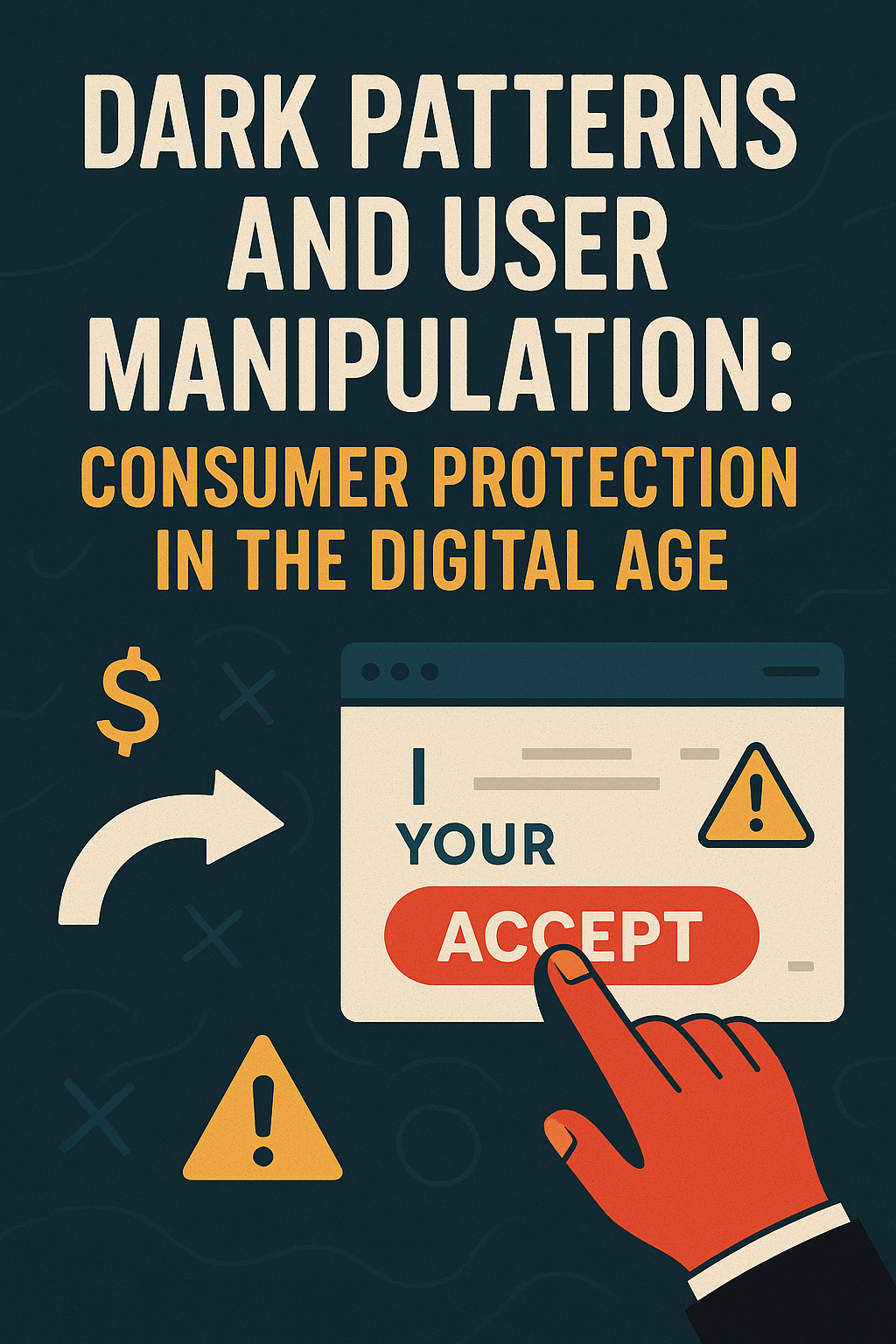
Dark patterns—deceptive design practices in digital interfaces—have emerged as a critical consumer protection concern in the modern digital economy. These manipulative techniques, a term popularized by user-experience designer Harry Brignull in 2010, deliberately obscure information or create false pressure to influence users into unintended actions. Common examples include making rejection buttons less visible than acceptance options, adding items to shopping carts without explicit consent, converting free trials into paid subscriptions without clear notification, or burying cancellation options behind confusing screens. While persuasive design itself is standard business practice, dark patterns cross an ethical and legal line by impairing consumer autonomy and informed decision-making. Recognizing this threat, India's Central Consumer Protection Authority issued the Guidelines for Prevention and Regulation of Dark Patterns in 2023 under the Consumer Protection Act, 2019, specifically addressing deceptive user-interface and user-experience practices. The proliferation of dark patterns reflects intense digital competition for clicks, subscriptions, sales, and user data. As e-commerce, data privacy, and digital regulation continue evolving globally, addressing dark patterns has become essential to protecting consumer rights and ensuring ethical digital design practices.
Share on

Dark Patterns in Modern Web Applications: Ethical Concerns and User Impact - Neliti
media.neliti.com
Oct. 9, 2026, 9:52 a.m.
Modern web applications increasingly employ dark patterns—manipulative design tactics that exploit cognitive biases and behavioral tendencies to influence user decisions against their interests. These patterns leverage urgency, default bias, and decision fatigue to drive unintended actions such as purchases, service sign-ups, or data sharing. A comprehensive research study analyzed diverse dark pattern categories through case-based examination of multiple platforms, identifying recurring design tactics while simultaneously surveying users to assess awareness levels. The research also addresses ethical implications and introduces a theoretical framework designed to identify and eliminate such patterns. Findings underscore the critical importance of transparency, ethical design principles, and user-centered usability in contemporary digital applications. As dark patterns become increasingly sophisticated, this analysis provides essential insights for developers, designers, and stakeholders seeking to prioritize user agency and informed decision-making in web application development.
Share on

Dark patterns under scrutiny: Why digital trust must be designed into consumer journeys
kpmg.com
Oct. 9, 2026, 9:52 a.m.
India's rapidly expanding digital economy has transformed consumer purchasing through websites and applications designed for convenience and personalization. However, these same design strategies can manipulate users into unintended actions through practices known as "dark patterns," including undisclosed charges, pre-selected options, artificial scarcity messaging, difficult cancellation processes, and design elements that artificially emphasize certain choices. Once considered merely a user-experience ethics issue, dark patterns have escalated into a regulatory concern, making fair digital design a critical business priority across e-commerce, travel, financial services, insurance, healthcare, and technology sectors. India's Central Consumer Protection Authority has recently taken enforcement action against multiple digital platforms, imposing penalties and mandating practice corrections for deceptive designs. The 2023 Guidelines for Prevention and Regulation of Dark Patterns define these as deceptive UI or UX interactions that mislead users into unintended actions. While digital features like prompts and personalized recommendations serve legitimate purposes, concerns arise when designs obscure important information, manufacture false urgency, or impede informed decision-making and service cancellation. This regulatory scrutiny directly impacts brand perception and organizational reputation, making compliance essential for platforms operating in India.
Share on

What Is Choice Architecture, and How Do You Use It?
www.optyoumize.com
Oct. 3, 2026, 7:25 a.m.
Choice architecture, a concept from behavioral economics popularized by Richard Thaler and Cass Sunstein in their book Nudge, refers to how options are organized and presented to influence decision-making. Rather than relying on willpower—a finite resource that fails in the long term—choice architecture redesigns environments to make desired choices easier and automatic. By adjusting defaults, layout, friction, and framing, organizations and individuals can reliably shape behavior without requiring sustained discipline. Examples include placing salad at eye level in cafeterias to increase healthy selections or making retirement savings automatic rather than opt-in, both demonstrating that modifying the architecture around choices accomplishes more than the choices themselves. This approach proves particularly valuable because it eliminates decisions entirely, reducing decision fatigue and mental energy expenditure. The article outlines five practical tools choice architects employ, emphasizing that effective design requires no additional motivation—only the absence of intervention. Understanding and applying choice architecture enables individuals to take control of their own decision-making environments rather than leaving them to chance or others' designs.
Share on

Promoting Sustainable Travel Intentions: The Effect of Information Nudges
www.frontiersin.org
Oct. 3, 2026, 7:25 a.m.
Tourism generates substantial global greenhouse gas emissions, necessitating a shift toward more sustainable travel choices. Despite widespread environmental awareness, a significant gap persists between travelers' ecological attitudes and their actual sustainable behaviors. Researchers from Heilbronn University's Institute of Tourism, Travel and Hospitality and the Center for Sustainable Tourism in Berlin conducted a study to address this attitude-intention gap through information nudges. The team executed randomized choice experiments involving 2,186 German holidaymakers across three major vacation segments: domestic and proximity tourism, mid-range Mediterranean travel, and long-haul journeys. Participants evaluated three different carbon-related information nudges against a control baseline without additional information. Results demonstrated that carbon emission disclosure significantly influenced travelers' pro-environmental intentions regarding transport mode and accommodation selections, though not all effects reached statistical significance. The findings underscore that communicating emissions data effectively narrows the attitude-intention gap among environmentally conscious travelers, offering a practical behavioral intervention strategy for reducing tourism-related carbon emissions. This research suggests policymakers and travel providers should prioritize transparent carbon communication to encourage climate-friendly travel decisions.
Share on

Making non-compliance visible: how smart bins reshape social norms in urban waste management
www.frontiersin.org
Oct. 3, 2026, 7:25 a.m.
Urban waste management systems increasingly implement controlled-access smart bins designed to enhance user compliance with waste separation norms while reducing operational costs associated with traditional door-to-door collection. A comprehensive survey of 502 participants in a large-scale Italian pilot project examined whether this technology achieves its intended outcomes. Integrating analytical sociology, social norms theory, and Science and Technology Studies, researchers identified three key mechanisms explaining the system's mixed results: limited internalization of waste separation norms, ineffective sanctions, and paradoxically, the increased visibility of non-compliant behavior. The study reveals that smart bins may reshape users' expectations about compliance, potentially eroding adherence to waste separation practices rather than strengthening it. While European policy—including the Sustainable Development Goals, the Circular Economy Action Plan, and regional waste management strategies—demonstrates broad institutional consensus on reducing waste generation and increasing separate collection, significant uncertainty persists regarding effective implementation methods. As waste management becomes critical to the socioecological transition in European cities, establishing systems that genuinely coordinate individual behavior with collection requirements remains a central governance challenge, suggesting that technological solutions alone may be insufficient without addressing underlying behavioral and social dimensions.
Share on

What is Behavioral Strategy?
behavioralstrategy.com
Oct. 3, 2026, 7:25 a.m.
Behavioral Strategy is an applied discipline developed by Jason Hreha that makes behavior the central unit of strategic planning for achieving desired outcomes. The approach involves defining target outcomes and populations, generating and evaluating multiple candidate behaviors, selecting the highest-fit option, validating Behavior Market Fit in real contexts, and designing integrated systems of products, programs, policies, and operations to enable sustainable behavior change. Unlike traditional behavioral management or generic behavior-change advice, this methodology recognizes that multiple behaviors can achieve identical outcomes and none is universally optimal. The framework employs several tools including the DRIVE Framework for process reference, the Four-Fit hierarchy for decision gates, and the Behavior Fit Assessment that evaluates Dispositional, Capability, and Context Fit dimensions. The approach also utilizes the Behavioral State Model to distinguish personal and contextual components for deeper diagnosis. By systematically comparing behavioral alternatives, investigating their contextual fit, and testing choices before implementation, Behavioral Strategy enables organizations to design systems where target behaviors occur reliably in real-world conditions, addressing the critical gap between intended outcomes and actual execution.

Replacing Dark Patterns with Fair Choice Architecture in
arxiv.org
Oct. 3, 2026, 7:24 a.m.
This research paper addresses the pervasive problem of dark patterns—deceptive interface designs that manipulate users into unintended actions—by proposing fair choice architecture as an alternative approach. Authored by Awakan, Aroonwechkul, Gunjoor, Khadka, and Das, the work examines how digital platforms exploit cognitive biases and behavioral psychology to influence user decisions against their interests. The study presents a comprehensive framework for redesigning user interfaces using fair choice architecture principles that prioritize transparency, user autonomy, and informed decision-making. Rather than relying on manipulative tactics like hidden cancellation buttons, misleading language, or pre-selected options, fair choice architecture implements design patterns that present information clearly and give users genuine control over their choices. The research demonstrates why this shift matters significantly: as regulatory bodies increasingly scrutinize dark patterns and companies face legal and reputational consequences, adopting ethical design practices becomes both a compliance necessity and a competitive advantage. The findings contribute to growing efforts in human-computer interaction and digital ethics to establish design standards that respect user agency while maintaining business objectives, ultimately fostering greater trust between platforms and users.
Share on